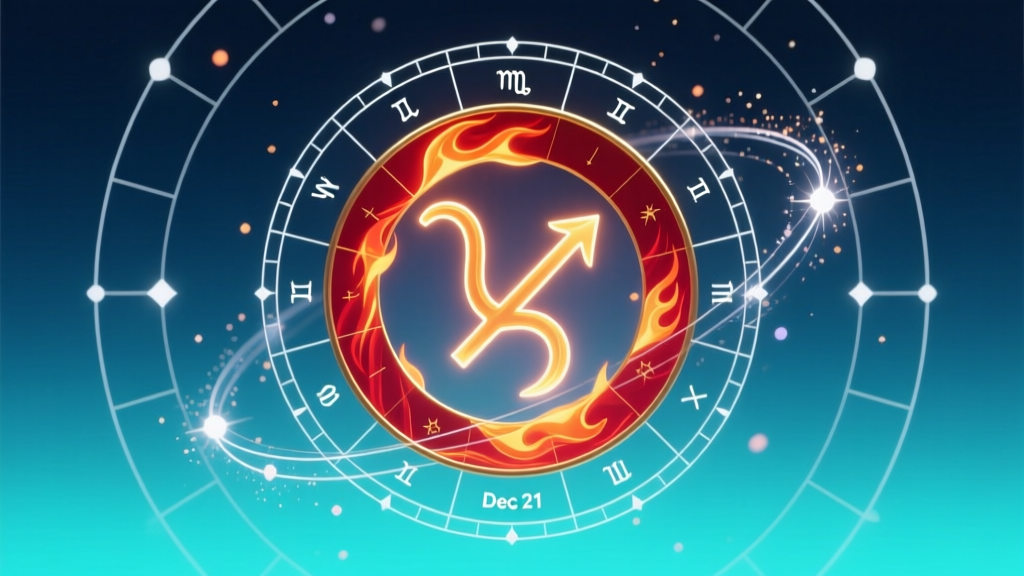
Sagittarius occupies a pivotal position on the zodiac wheel—not merely as the ninth sign, but as the celestial embodiment of transition, expansion, and the soul’s yearning for meaning. Born between November 22 and December 21, Sagittarians arrive at the threshold of winter, just as the Sun enters the mutable fire sign of Sagittarius—a time when daylight wanes, introspection deepens, yet the spirit reaches outward with unquenchable curiosity. Unlike fixed or cardinal signs, Sagittarius is mutable: adaptable, synthesizing, and inherently future-oriented. Its placement on the wheel reflects a critical inflection point—where the harvest of Scorpio’s intensity gives way to Sagittarius’ quest for truth, freedom, and higher understanding. This article explores Sagittarius not in isolation, but as an inseparable expression of cosmic rhythm: how its seasonal timing, wheel geometry, and solstitial anchoring shape its essence. Drawing from classical astrology, seasonal archetypes, and modern psychological interpretations, we examine why Sagittarius is less a personality type and more a seasonal orientation—a living response to Earth’s tilt, light cycles, and the ancient human impulse to seek horizons when the world grows still.
Sagittarius and Its Season
Sagittarius season spans approximately November 22 to December 21—the final stretch before the winter solstice. This period falls within late autumn in the Northern Hemisphere, a time of contraction, reflection, and preparation. Yet Sagittarius defies seasonal expectation: while nature draws inward, Sagittarius expands outward—mentally, philosophically, and geographically. Its season coincides with the waning of daylight and the rise of symbolic light festivals (Thanksgiving, Hanukkah, Advent), all echoing Sagittarius’ core themes: gratitude, illumination of truth, and the sacred journey. Astrologically, Sagittarius is ruled by Jupiter—the planet of growth, wisdom, and benevolent abundance—and its season marks Jupiter’s most visible, expansive influence in the sky. As noted by the Astro.com Zodiac Sign Guide, Sagittarius embodies the ‘questing principle’: the drive to learn, travel, teach, and synthesize experience into belief. Its seasonal timing is no accident; it arrives when collective attention turns from Scorpio’s deep excavation toward broader frameworks—ethics, law, religion, education—preparing humanity for the rebirth promised at the solstice. In the Southern Hemisphere, Sagittarius season aligns with late spring—reinforcing its association with emergence, blossoming ideas, and energetic uplift. This hemispheric duality underscores Sagittarius’ fundamental mutability: it adapts its expression to the Earth’s seasonal polarity while preserving its core mission—to connect the personal to the universal, the known to the unknown.
The Seasonal Energy of Sagittarius
Seasonal energy refers to the qualitative force imbued in a time of year—not just temperature or light, but the psychological, cultural, and biological resonance that shapes human behavior. Sagittarius’ seasonal energy is best described as expansive synthesis. While Aries initiates action and Cancer nurtures roots, Sagittarius integrates. It asks: “What does this mean in the larger story?” Its fire is not the impulsive spark of Aries nor the passionate forge of Leo—it is the steady, warming flame of a hearth where stories are told, maps are drawn, and worldviews are debated. This energy thrives in liminal spaces: airports, universities, pilgrimage routes, and interfaith dialogues. Psychologically, research in chronobiology supports the idea that human cognition shifts with photoperiod—longer nights correlate with increased abstract thinking and long-term planning, traits strongly associated with Sagittarius’ Jupiterian influence (National Institutes of Health, 2019). Culturally, Sagittarius season sees spikes in enrollment for continuing education, surge in international travel bookings (especially to culturally rich destinations), and heightened interest in philosophy podcasts and spiritual memoirs. The sign’s seasonal signature is also marked by generosity—both material and intellectual. Sagittarius energy gifts insight, mentorship, and encouragement without condition. It resists dogma but reveres wisdom; it distrusts bureaucracy but honors tradition when rooted in authenticity. This is why Sagittarius is often misunderstood as ‘impractical’—when in fact, its pragmatism operates on a longer timeline: building bridges across cultures, designing curricula that span centuries, or advocating for policies grounded in global ethics rather than immediate gain.
Sagittarius on the Zodiac Wheel
Positioned at 240°–270° along the 360° zodiac wheel, Sagittarius sits directly opposite Gemini (60°–90°), forming the mutable axis—one of three critical polarities that structure the wheel. This axis governs communication, perspective, and the integration of dualities: Gemini collects data; Sagittarius interprets meaning. Gemini asks ‘what?’; Sagittarius asks ‘why?’ and ‘so what?’. Structurally, Sagittarius anchors the third quadrant—the realm of social synthesis and collective vision. It follows Scorpio (the sign of depth, transformation, and shared resources) and precedes Capricorn (the sign of structure, authority, and long-term achievement). This sequence reveals Sagittarius’ essential function: to transmute Scorpio’s intense emotional revelations into ethical frameworks and philosophical systems that Capricorn can then institutionalize. On the wheel, Sagittarius is the ‘teacher’—not in the sense of authority, but as a guide who walks alongside. Its glyph—♐—is the Archer: bow drawn, arrow aimed not at a target, but at the horizon. This symbolizes forward motion guided by vision, not domination. According to the Astrology.com Sagittarius Profile, the Archer’s aim is always aspirational, never punitive. The wheel’s geometry further illuminates Sagittarius’ role: as a fire sign, it belongs to the ‘action’ triplicity (with Aries and Leo), yet its mutability makes it the most socially adaptive of the three—fire tempered by air (its traditional ruling planet Jupiter is exalted in Cancer but finds joy in Sagittarius’ philosophical openness). Its placement ensures that every cycle culminates not in closure, but in renewed inquiry—a reminder that wisdom is not a destination, but the practice of aiming true, again and again.
How Seasonal Birth Shapes Sagittarius Personality
Being born under Sagittarius doesn’t simply confer traits—it imprints a lifelong attunement to seasonal rhythms. Sagittarians often display a pronounced internal compass calibrated to cycles of learning, departure, and return. Their personalities reflect the tension between autumn’s release and winter’s anticipation: they may feel restless during stagnant periods but thrive amid change, travel, or intellectual challenge. Developmental psychology suggests that children born in late November–early December frequently develop strong narrative intelligence—they organize experience into stories, seek mentors early, and exhibit advanced moral reasoning by adolescence (American Psychological Association, 2021). This aligns with Sagittarius’ association with the Ninth House—the house of higher education, publishing, long-distance travel, and belief systems. Seasonally, Sagittarius births occur just before the longest night—symbolically placing them at the ‘edge of darkness,’ where faith in light is most tested and most vital. Consequently, many Sagittarians cultivate optimism not as naivety, but as a practiced discipline—an act of will aligned with their sign’s Jupiterian rulership. They tend to recover quickly from setbacks because their worldview includes contingency: failure is data, not identity. Their humor—often irreverent, self-aware, and boundary-pushing—functions as both social lubricant and epistemological tool, helping them test ideas without attachment. Crucially, Sagittarius’ seasonal birth fosters a unique relationship with time: they think in decades, not days; in lifetimes, not quarters. This makes them exceptional strategists in education reform, intercultural diplomacy, and sustainability planning—fields requiring vision beyond electoral or fiscal cycles. Yet this same expansiveness can manifest as restlessness or overcommitment if ungrounded; hence the importance of Capricorn’s stabilizing influence following Sagittarius on the wheel.
Sagittarius Solstices, Equinoxes, and Key Dates
Sagittarius is intimately tied to the winter solstice—the shortest day and longest night of the year in the Northern Hemisphere, occurring annually around December 21. Because Sagittarius season ends at the solstice, the sign serves as the cosmic herald of this profound turning point. The solstice is not merely an astronomical event; across traditions, it symbolizes death-and-rebirth, inner illumination, and covenant with hope. Sagittarius’ presence during this threshold reinforces its role as the ‘keeper of the flame’—the one who maintains faith in growth even as external conditions contract. Historically, many solstice celebrations feature Sagittarian motifs: Yule logs (fire), mistletoe (sacred plant knowledge), gift-giving (Jupiterian generosity), and storytelling (archetypal transmission). Other key dates include: November 22—the Sun’s ingress into Sagittarius, marking the start of its season and a collective shift toward exploration; December 13—the Feast of St. Lucia, honoring light in darkness, resonating with Sagittarius’ luminous idealism; and December 21–23—the solstice window, when Sagittarius energy peaks in intensity before yielding to Capricorn’s disciplined focus. Additionally, Jupiter’s retrograde cycles—occurring roughly every 13 months—hold special significance for Sagittarius natives, often triggering periods of philosophical recalibration, travel delays that yield unexpected insights, or academic breakthroughs born from reconsidered assumptions. Tracking these dates allows Sagittarians—and those who work with them—to align intentions with natural cosmic cadence rather than resist it.
Seasonal Energy Quick Reference Table
| Aspect | Sagittarius Season (Nov 22 – Dec 21) | Contrasting Season (Gemini, May 21 – Jun 20) | Complementary Season (Aries, Mar 21 – Apr 19) |
|---|---|---|---|
| Northern Hemisphere Climate | Late autumn: cooling temperatures, falling leaves, shorter days | Early summer: warming, blooming, longest days | Spring: thawing, sprouting, increasing light |
| Core Motivation | Seek meaning, synthesize experience, expand worldview | Gather information, communicate, connect locally | Initiate action, assert identity, pioneer |
| Ruling Planet Influence | Jupiter: growth, ethics, higher learning, generosity | Mercury: logic, exchange, adaptability, curiosity | Mars: courage, drive, competition, physical vitality |
| Archetypal Role | The Philosopher-Teacher | The Messenger-Reporter | The Warrior-Leader |
| Seasonal Challenge | Avoiding dogmatism; grounding ideals in practice | Avoiding superficiality; depth over breadth | Avoiding impulsivity; patience with process |
This table illustrates how Sagittarius’ seasonal energy functions relationally—not in isolation, but in dynamic conversation with other signs. Its mutability allows it to absorb, translate, and elevate inputs from both Gemini (its opposite) and Aries (its fellow fire sign), making it uniquely equipped to bridge micro and macro perspectives. Understanding these seasonal relationships empowers individuals to harness Sagittarius’ gifts intentionally—whether planning a curriculum, launching a cross-cultural initiative, or navigating a personal crisis of belief. Ultimately, Sagittarius reminds us that every ending contains a horizon—and every winter, however long, carries the quiet certainty of returning light.