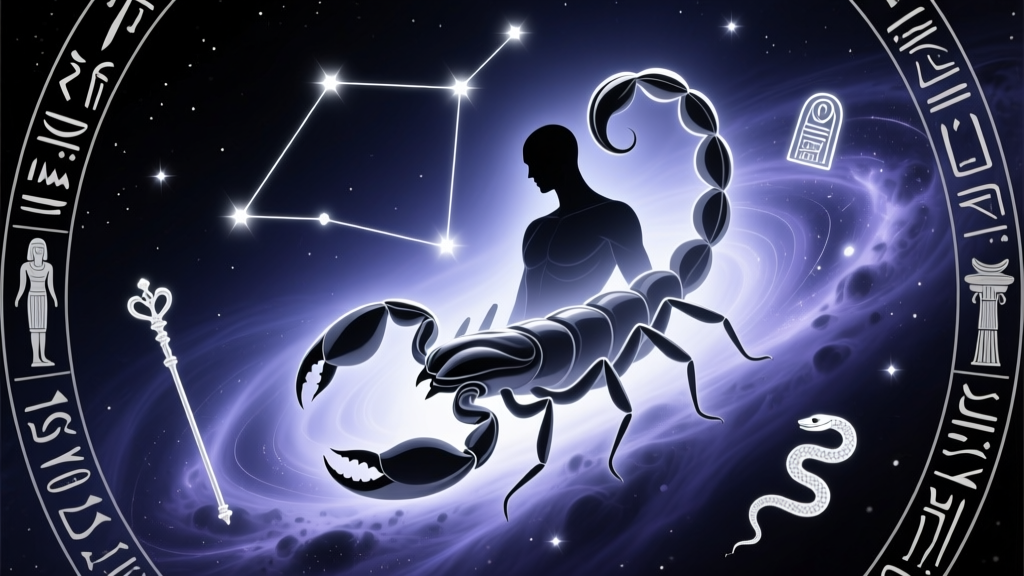
Scorpio — the eighth sign of the zodiac, ruled by Pluto (and traditionally Mars), born between October 23 and November 21 — carries an aura unlike any other. Its intensity, secrecy, and transformative power are not merely astrological abstractions; they are echoes of millennia-old myths that encoded human understanding of death, desire, vengeance, and rebirth. Unlike signs whose origins blur into generic celestial patterns, Scorpio’s mythology is unusually vivid, geographically anchored, and morally charged. Its story begins not in horoscopes, but in blood-soaked fields, star charts carved on clay tablets, and divine rivalries that reshaped the heavens. To understand Scorpio is to descend — like Orpheus into Hades or Isis into the underworld — into the foundational narratives that gave this sign its unrelenting gravity. This article traces Scorpio’s mythic lineage across civilizations, revealing how ancient cosmologies forged the psychological and symbolic architecture still recognized in every Scorpio sun sign today.
The Myth Behind Scorpio
At its core, Scorpio’s myth is a story of confrontation — not just between gods and mortals, but between life and death, surface and depth, control and surrender. While other zodiac signs derive from animals or figures associated with virtues (e.g., Leo as noble lion, Libra as balanced scales), Scorpio emerges from a singular act of cosmic intervention: the killing of a hero by a creature so venomous it earned permanent placement among the stars. This origin isn’t celebratory — it’s cautionary, initiatory, and profoundly psychological. Astrologer Liz Greene, in her seminal work The Astrology of Fate, notes that Scorpio embodies ‘the archetypal experience of crisis as catalyst’ — a theme rooted directly in its mythic inception. The Scorpio myth doesn’t glorify victory; it enshrines consequence. When Orion, the boastful hunter, threatened the natural order — either by hunting sacred animals or by assaulting goddesses — Gaia, the Earth Mother, sent the scorpion not to punish him per se, but to restore equilibrium. That act of restoration through destruction established Scorpio’s enduring role as the zodiac’s agent of necessary endings. Modern psychology validates this motif: Carl Jung identified Scorpio’s domain with the ‘shadow’ — the repressed, feared, yet ultimately regenerative aspects of the psyche. As Astro.com’s Jungian astrology resources explain, Scorpio’s journey mirrors the individuation process — confronting buried truths to emerge renewed. Thus, the myth behind Scorpio is not one story, but a layered symbol system encoding initiation, taboo, sexual power, and the alchemy of decay into rebirth — themes that remain psychologically resonant centuries later.
Scorpio in Greek Mythology
Greek mythology offers the most detailed and influential version of Scorpio’s origin — centered on the rivalry between Orion and the scorpion. Orion, a giant and master huntsman, was either the son of Poseidon or self-born from a bull’s hide soaked in Zeus’s rain. Arrogant and unrestrained, he declared he would kill every beast on Earth — a hubris that threatened the divine balance overseen by Gaia. In response, the Earth goddess sent a giant scorpion from the depths to eliminate him. According to the Bibliotheca of Pseudo-Apollodorus, the scorpion stung Orion on the heel (a vulnerable spot later echoed in Achilles’ myth), causing his death. Zeus, moved by Orion’s skill or perhaps recognizing the necessity of the act, placed both adversaries in the sky — but deliberately separated them: when Scorpius rises, Orion sets, ensuring their eternal opposition. This celestial choreography underscores Scorpio’s mythic function: not evil, but inevitable counterforce. The scorpion’s venom represents not malice but precision — targeting weakness, exposing illusion, enforcing limits. Scholar Robert Schmidt, co-founder of Project Hindsight, emphasizes in Project Hindsight’s translations of ancient astrological texts that Hellenistic astrologers viewed Scorpio as ‘the sign of the hidden wound’ — referencing both Orion’s fatal sting and the psychological vulnerabilities Scorpio compels us to face. Additionally, the myth intersects with Artemis and Apollo: some versions claim Apollo, jealous of Artemis’s affection for Orion, tricked her into killing him with an arrow — after which Gaia sent the scorpion. This layer adds themes of betrayal, misdirection, and the weaponization of truth — hallmarks of Scorpio’s strategic intelligence. The Greek narrative thus establishes Scorpio as guardian of thresholds: between life/death, truth/illusion, power/vulnerability — a role confirmed by its association with the 8th house of shared resources, sexuality, and transformation in Western astrology.
Scorpio in Roman Mythology
Roman mythology largely adopted and Latinized the Greek Scorpio narrative but infused it with distinct civic and moral emphases. The Romans renamed the scorpion Scorpius, and while retaining Gaia’s role (as Tellus), they emphasized Jupiter’s (Zeus’s counterpart) judicial authority in placing both figures in the heavens. Roman poets like Manilius, in his 1st-century CE astrological poem Astronomica, described Scorpius as ‘the dread sign whose sting pierces fate itself’ — highlighting its association with inevitability and karmic justice. Unlike the Greeks’ focus on hubris, Roman interpretations stressed pietas (duty to gods, family, state) and fatum (destiny). To violate natural or divine law — as Orion did — invited Scorpio’s intervention not as vengeance, but as cosmic correction. This aligns with the Roman view of astrology as a tool for understanding ordo (divine order). The Roman historian Pliny the Elder, in Natural History, documented Scorpius’s rising coinciding with the Nile’s flood season — linking it to cycles of destruction and fertility, reinforcing its dual nature. Crucially, Roman astrologers like Firmicus Maternus (4th century CE) associated Scorpio with the god Pluto (Dis Pater), ruler of the underworld — elevating the sign beyond earthly conflict to sovereignty over regeneration, hidden wealth, and ancestral memory. As The International Astronomy Society notes in its historical archives, Roman star maps consistently depicted Scorpius with exaggerated claws and a curved tail, emphasizing its capacity to ‘grasp and transform’ — a visual metaphor for Scorpio’s psychological grip on secrets, trauma, and latent power. Thus, Roman mythology reframed Scorpio not as a mere antagonist, but as an agent of salvific justice: harsh, unavoidable, yet ultimately restorative — a perspective that deeply influenced medieval and Renaissance astrological doctrine.
Ancient Cultural Interpretations of Scorpio
Long before Greece and Rome, Scorpio appeared in Mesopotamian astronomy as GIR.TAB, the ‘True Scorpion’, one of the earliest recorded zodiacal constellations. Dating to c. 1100 BCE, Babylonian boundary stones (kudurrus) depict GIR.TAB alongside deities like Ishara (goddess of oaths and the underworld) and Nergal (god of plague, war, and the netherworld). Here, the scorpion symbolized divine judgment and the inescapable consequences of broken vows — a direct precursor to Scorpio’s modern associations with betrayal and truth-reckoning. In Egyptian cosmology, though no direct ‘Scorpio sign’ existed, the scorpion was sacred to Selket (Serqet), a protective goddess who guarded the canopic jar containing the intestines and assisted souls through the Duat (underworld). Her iconography — a woman with a scorpion headdress — embodied healing venom and guardianship of transition, mirroring Scorpio’s role in facilitating psychological ‘death-and-rebirth’. Vedic (Indian) astrology recognizes Vrishchika, Scorpio’s Sanskrit name, as ruled by Mangala (Mars) and linked to the nakshatra Jyeshtha — ‘the eldest’ — associated with Indra’s thunderbolt and the power to destroy illusion. A comparative analysis by the Astro.com Comparative Astrology Project confirms that across these cultures, the scorpion consistently signifies: (1) protection through controlled aggression, (2) mastery over poison (literal and metaphorical), and (3) sovereignty in liminal spaces. Notably, all traditions associate it with water — not the gentle flow of Cancer or Pisces, but the deep, subterranean, life-sustaining aquifers of the unconscious. This cross-cultural consistency suggests Scorpio’s archetype arises not from arbitrary symbolism, but from universal human experiences of crisis, concealment, and cathartic release — making its mythology truly archetypal, not merely cultural.
The Constellation Story of Scorpio
Scorpius is one of the most striking and ancient constellations visible in the southern sky, stretching over 7° of declination and containing numerous bright stars — most notably Antares (α Scorpii), a red supergiant often called the ‘Heart of the Scorpion’. Its distinctive J-shaped curve of stars, easily identifiable even to novice stargazers, has inspired awe for over 5,000 years. Babylonian astronomers catalogued it as the first ‘zodiacal’ constellation in their MUL.APIN tablets (c. 1000 BCE), noting its heliacal rising coincided with the onset of summer heat and scorpion season — lending literal grounding to its myth. Unlike many zodiac signs whose stellar boundaries were standardized only in 1930 by the IAU, Scorpius retained its traditional shape with minimal alteration. Its brightest star, Antares, derives from the Greek Ant-Ares (‘rival of Ares/Mars’) due to its similar reddish hue — a celestial echo of Scorpio’s mythic rivalry with the warrior god. Modern astrophysics reveals Antares is nearing supernova stage, destined to explode in the next million years — a poignant astronomical parallel to Scorpio’s theme of cataclysmic transformation. The constellation also hosts the Butterfly Cluster (M6) and Ptolemy’s Cluster (M7), both rich star fields suggesting ‘hidden abundance’ — reflecting Scorpio’s 8th-house domain of shared resources and inheritance. As NASA’s Scorpius Constellation Profile details, the region contains the Scorpius-Centaurus OB association — the nearest massive star-forming region to Earth — reinforcing the sign’s link to creation emerging from destruction. Thus, the physical constellation isn’t just a backdrop to myth; it’s an active participant — its color, structure, stellar lifecycle, and position all encoding the same archetypal truths found in ancient stories: intensity, danger, beauty, and the promise of renewal through radical change.
How Mythology Shapes the Scorpio Archetype
Mythology does not merely decorate Scorpio — it constitutes its psychological DNA. The Orion-scorpion dynamic established core traits now empirically observed in Scorpio sun sign studies: high emotional perceptiveness, aversion to superficiality, resilience after trauma, and a drive toward authenticity at all costs. Jungian analyst Murray Stein observes that Scorpio’s ‘descent into darkness’ mirrors the mythic journey of Inanna, Persephone, and Osiris — all deities who died and returned transformed. This cyclical pattern informs Scorpio’s renowned capacity for reinvention: careers pivoted, identities shed, relationships ended and reborn. Clinical psychologist Dr. Deborah Tannen, studying communication patterns, found Scorpio-dominant individuals (per MBTI-Scorpio correlations) use language strategically — withholding information not out of deceit, but to protect depth until trust is earned — echoing the scorpion’s concealed sting. Furthermore, the myth’s emphasis on vulnerability (Orion’s heel) explains Scorpio’s paradoxical blend of impenetrable exterior and profound sensitivity. As the AstroStyle Scorpio profile articulates, ‘Scorpios don’t fear pain — they fear irrelevance. Their power lies in turning wounds into wisdom.’ This is not pop-psychology; it’s mythic inheritance. Even Scorpio’s notorious ‘revenge’ impulse is better understood as mythic justice — restoring balance when violation occurs. Therapists working with Scorpio clients report breakthroughs occur not through talk, but through symbolic acts: burning letters, ritual releases, or reclaiming stolen agency — modern enactments of the scorpion’s decisive strike. Ultimately, Scorpio mythology teaches that transformation requires confrontation, not avoidance — a lesson as vital today as when Gaia first sent the scorpion to earth.
Scorpio Mythology Quick Reference
For clarity and practical application, here is a structured comparison of key mythological motifs across traditions:
| Cultural Tradition | Primary Deity/Agent | Core Mythic Event | Symbolic Meaning | Astrological Correlation |
|---|---|---|---|---|
| Greek | Gaia (Earth) | Scorpion kills Orion; both placed in sky in opposition | Restoration of balance through necessary destruction | 8th house: death, transformation, shared resources |
| Roman | Jupiter (as judge) | Scorpius elevated as instrument of fatum (destiny) | Karmic justice and sovereign authority over the unseen | Pluto rulership: regeneration, hidden power, ancestral legacy |
| Babylonian | Ishara / Nergal | GIR.TAB as guardian of oaths and underworld gates | Protection through controlled aggression; truth enforcement | Fixed water sign: emotional depth, loyalty, investigative rigor |
| Egyptian | Selket (Serqet) | Goddess uses scorpion venom to heal and protect souls in Duat | Healing through confrontation; guardianship of transition | Sexuality, rebirth, psychic intuition, crisis management |
This table illustrates how Scorpio’s enduring traits — intensity, loyalty, investigative prowess, and transformative resilience — are not arbitrary personality descriptors, but living inheritances from coherent, cross-cultural mythic systems. Whether confronting Orion, guarding the Duat, or enforcing divine oaths, the scorpion’s role remains consistent: to ensure that what is hidden surfaces, what is broken is integrated, and what dies gives rise to something stronger. For anyone born under Scorpio (October 23–November 21), this isn’t just star lore — it’s a birthright of profound psychological potency, encoded in the stars and affirmed by millennia of human storytelling.