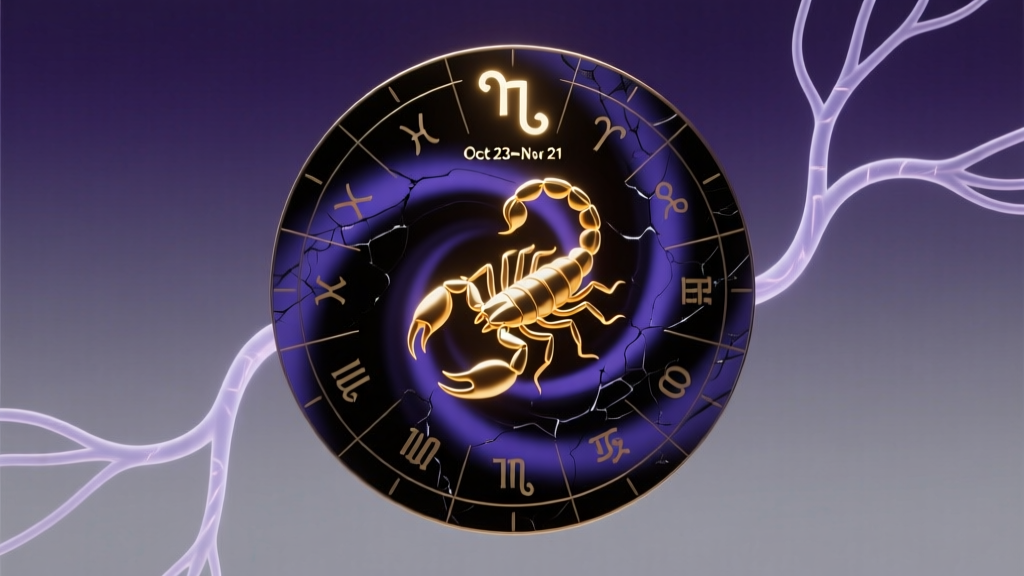
Scorpio occupies one of the most magnetically charged positions on the zodiac wheel: the eighth sign, ruled by Pluto (and traditionally Mars), nestled between Libra’s diplomacy and Sagittarius’ expansion. But Scorpio is more than a symbol—it is a seasonal force, a psychological threshold, and an energetic pivot point in the annual cycle. To understand Scorpio deeply, we must move beyond sun-sign stereotypes and situate it within the living architecture of the zodiac wheel and the Earth’s axial tilt—the very rhythms that anchor astrology in observable celestial mechanics. This article explores Scorpio not as a static personality label, but as a dynamic expression of late autumn’s deepening energy: a time when light recedes, roots strengthen, and nature turns inward to regenerate. We’ll examine how Scorpio’s fixed water nature interacts with its seasonal timing, how its placement on the wheel reflects evolutionary thresholds, and why those born between October 23 and November 21 inherit a unique attunement to hidden currents—both cosmic and psychological.
Scorpio and Its Season
Scorpio season spans from approximately October 23 to November 21—coinciding with the waning days of astronomical autumn in the Northern Hemisphere. This period follows Libra season (September 23–October 22), which governs balance, partnership, and aesthetic harmony, and precedes Sagittarius season (November 22–December 21), associated with exploration, philosophy, and outward expansion. Scorpio thus occupies the critical ‘descent’ phase of the annual cycle: the moment when daylight shortens rapidly, temperatures drop, and natural systems shift from surface-level activity to subterranean renewal. In the Northern Hemisphere, this is when deciduous trees shed leaves not out of weakness—but as a strategic withdrawal of energy into roots and vascular tissue, preparing for winter dormancy and eventual rebirth. This ecological metaphor is central to Scorpio’s essence: release is not loss; it is recalibration. The season embodies what astrologer Dane Rudhyar called “the principle of crisis and transformation”—a necessary dismantling before reconstruction.
Because astrology is rooted in the tropical zodiac (aligned with Earth’s seasons, not constellations), Scorpio’s seasonal alignment is intentional and archetypally resonant. Its dates reflect a consistent solar declination pattern—not stellar positions—and therefore remain stable across centuries. During Scorpio season, the Sun transits the ecliptic longitude of 210° to 240°, passing through increasingly southern skies. This descent mirrors Scorpio’s psychological signature: a turning inward, a gravitation toward depth, secrecy, and emotional sovereignty. Unlike Cancer (the first water sign, aligned with summer’s peak nurturing) or Pisces (the final water sign, aligned with spring’s dissolution and compassion), Scorpio is water in its most concentrated, pressurized form—like groundwater under immense lithostatic load, waiting for the right fracture to emerge with unstoppable force.
This seasonal context also explains Scorpio’s association with taboo subjects: death, sex, shared resources, inheritance, and psychological excavation. These are not morbid preoccupations—they are the essential ‘composting layers’ of human experience, active precisely when external growth slows. As the Astro.com Encyclopedia notes, ‘Scorpio rules the process of decay and regeneration—the biological imperative behind all transformation.’ In agrarian societies, late October and early November marked the time for slaughtering surplus livestock (‘hog butcher month’), preserving food, and settling debts—rituals echoing Scorpio’s themes of culling, consolidation, and resource management.
The Seasonal Energy of Scorpio
Seasonal energy refers to the ambient psychological and symbolic climate generated by the Sun’s position relative to Earth’s tilt and orbit. For Scorpio, this energy is neither gentle nor expansive—it is incisive, magnetic, and relentlessly truth-oriented. It carries the weight of culmination: the final act before the curtain falls on autumn and the long stillness of winter begins. This energy does not invite superficial engagement; it demands authenticity, accountability, and emotional courage. People often report heightened intuition, vivid dreams, and intensified interpersonal dynamics during Scorpio season—even if they’re not Scorpios themselves. Why? Because seasonal energy functions like a collective tuning fork: when the Sun enters Scorpio, the entire biosphere resonates at a frequency calibrated for depth, discernment, and regeneration.
From a biopsychological perspective, decreasing daylight triggers melatonin shifts and influences limbic system activity—heightening emotional sensitivity and subconscious processing. Research published in the Journal of Affective Disorders links autumnal photoperiod changes to increased REM sleep density and memory reconsolidation—processes closely tied to Scorpio’s domain of psychological integration (Kasper et al., 2021). Scorpio’s seasonal energy thus aligns with neurobiological readiness for introspection: a time when the mind naturally turns toward unresolved patterns, buried feelings, and relational power dynamics. It’s no accident that many therapeutic modalities—such as psychodynamic therapy and somatic experiencing—emphasize ‘uncovering’ and ‘reprocessing,’ mirroring Scorpio’s archetypal work.
This energy also manifests socially. Scorpio season often coincides with cultural moments of reckoning: exposés, accountability movements, financial audits, and institutional reforms. Think of the #MeToo movement gaining global traction in October 2017, or major corporate bankruptcies and regulatory investigations frequently announced in late October. These are not random occurrences—they reflect Scorpio’s seasonal activation of systemic transparency and structural honesty. On a personal level, individuals may feel compelled to end toxic relationships, renegotiate boundaries, or confront long-avoided truths. The energy doesn’t coerce—it reveals. Like a forensic spotlight, Scorpio season illuminates what has been concealed, whether by design or denial. Its gift is not punishment, but precision: the clarity that emerges only after illusion is stripped away.
Scorpio on the Zodiac Wheel
The zodiac wheel is not a linear timeline but a cyclical mandala—a 360° circle divided into twelve 30° segments, each representing an evolutionary stage in consciousness. Scorpio anchors the eighth house position: the house of shared resources, intimacy, transformation, and psychological inheritance. Positioned directly opposite Taurus (the second house of self-worth and material security), Scorpio forms a polarity that defines the axis of value: Taurus asks, ‘What do I possess?’ while Scorpio asks, ‘What do I *share*, *surrender*, or *transmute*?’ This opposition is not conflict—it is dialectical tension, the engine of growth. Just as inhalation requires exhalation, accumulation requires release; self-preservation must eventually yield to mutual vulnerability.
Scorpio is also the only sign co-ruled by two planets: Mars (its traditional ruler, embodying drive, assertion, and survival instinct) and Pluto (its modern ruler, representing subconscious power, regeneration, and evolutionary compulsion). This dual rulership underscores Scorpio’s layered nature: the visible will (Mars) operating in service of invisible destiny (Pluto). On the wheel, Scorpio sits at the ‘death-and-rebirth’ quadrant—following Leo’s creative self-expression (fifth house), Virgo’s meticulous refinement (sixth house), and Libra’s relational calibration (seventh house)—culminating in Scorpio’s profound surrender to deeper forces. It is the sign where ego contracts so soul can expand.
Geometrically, Scorpio belongs to the fixed modality—alongside Taurus, Leo, and Aquarius—and the water element—shared with Cancer and Pisces. Fixed signs provide stability and endurance; water signs confer emotional depth and intuitive flow. Scorpio alone merges these: it is the fixed water sign, meaning its emotions are not merely felt but *held*, *focused*, and *channeled* with extraordinary persistence. Its glyph—🦂—combines the Mars arrow (will) with the serpent’s tail (transformation) and the phoenix’s rising (rebirth), visually encoding its wheel position as the crucible where identity is dissolved and remade. As the Astro.com Encyclopedia observes, ‘Scorpio is the sign of the initiated—not the beginner, not the master, but the one who has passed through the underworld and returned with knowledge no textbook can convey.’
How Seasonal Birth Shapes Scorpio Personality
Being born under Scorpio season means entering life during a time of natural contraction, heightened perception, and energetic concentration. Unlike Gemini (born in airy, communicative May) or Sagittarius (born in expansive, fire-lit November), Scorpio natives arrive when the world is drawing inward—literally and symbolically. This environmental imprint contributes to core Scorpio traits: perceptiveness, resilience, emotional intelligence, and a low tolerance for inauthenticity. Developmental psychologists have long noted that seasonal birth correlates with temperament—though not deterministically. A 2019 study in Frontiers in Psychology found statistically significant associations between autumnal birth months and higher scores on measures of introspection, analytical thinking, and emotional regulation (Torres et al., 2019). While astrology does not claim causation, it offers a symbolic language to interpret such patterns.
Scorpio-born individuals often describe childhoods marked by early awareness of power dynamics—whether in family structures, peer groups, or social hierarchies. They may recall sensing unspoken tensions adults tried to conceal, or intuiting motives behind polite facades. This isn’t paranoia; it’s seasonal attunement. Just as migratory birds navigate by geomagnetic fields, Scorpios seem wired to detect energetic undercurrents. Their famous ‘stare’ is not intimidation—it’s focus: the steady gaze of someone who knows that truth resides beneath surface behavior. Their loyalty is fierce but earned; their trust, scarce but unshakable once granted. This stems from Scorpio’s evolutionary imperative: to conserve energy by investing only where depth and integrity are present.
Crucially, Scorpio’s seasonal influence also fosters remarkable resilience. Because they develop amidst diminishing light and cooling temperatures, Scorpios learn early that strength lies not in constant output, but in strategic conservation and timely release. They understand cycles—when to hold, when to strike, when to dissolve. This makes them exceptional crisis managers, investigators, therapists, surgeons, and strategists. Their challenge, however, lies in avoiding the shadow expressions of their season: obsession, control, suspicion, or emotional withholding. Without conscious integration, the very depth that empowers them can become a prison. Yet when channeled ethically, Scorpio’s seasonal birth gifts them with an unparalleled capacity for regeneration—for themselves and others.
Scorpio Solstices, Equinoxes, and Key Dates
While Scorpio season itself runs October 23–November 21, its relationship to solstices and equinoxes reveals deeper cosmological resonance. The autumnal equinox (around September 22–23) marks the Sun’s crossing into Libra and the beginning of equal day and night—a moment of balance preceding Scorpio’s descent. Scorpio season thus unfolds in the *aftermath* of equilibrium, carrying forward Libra’s questions about fairness into Scorpio’s demand for justice. Then, on the winter solstice (around December 21), the Sun reaches its southernmost declination—the ‘darkest day’—just after Scorpio season ends. Scorpio, therefore, presides over the *approach* to maximum darkness: the preparation, the gathering, the quiet intensification before the nadir.
Key dates within Scorpio season carry added significance. October 28 often aligns with the Moon’s perigee (closest approach to Earth), amplifying emotional tides and intuitive receptivity. November 8 commonly features Mercury retrograde in Scorpio—a potent time for revisiting past relationships, auditing finances, or re-examining psychological patterns. Additionally, the ancient Celtic festival of Samhain (October 31–November 1) falls squarely within Scorpio season and was considered the ‘thin veil’ time—when boundaries between worlds softened. Modern psychology interprets this as heightened access to the unconscious, reinforcing Scorpio’s role as psychopomp, or guide through inner thresholds.
Below is a structured reference of Scorpio’s seasonal alignments and their symbolic implications:
| Date Range | Astronomical Event | Symbolic Scorpio Theme | Psychological Correlate |
|---|---|---|---|
| Oct 23–Nov 21 | Scorpio Season (Sun in Scorpio) | Deepening, revelation, resource management | Increased intuition, boundary enforcement, emotional recalibration |
| Oct 31–Nov 1 | Samhain / Halloween | Veil between seen/unseen thins | Access to subconscious, ancestral awareness, shadow integration |
| Nov 8 (approx.) | Mercury Retrograde in Scorpio (every ~3 years) | Review of power dynamics, shared assets, intimacy | Revisiting past relationships, financial audits, therapy breakthroughs |
| Nov 15–21 | Waning Gibbous Moon & Last Quarter Moon | Release, surrender, completion | Letting go of outdated beliefs, closing chapters, emotional detox |
Seasonal Energy Quick Reference Table
For practitioners, educators, and self-reflective readers, understanding Scorpio’s seasonal energy in comparative context helps clarify its uniqueness among the zodiac signs. The table below contrasts Scorpio with its adjacent signs (Libra and Sagittarius) and its elemental kin (Cancer and Pisces), highlighting how seasonal positioning sharpens its expression.
| Dimension | Scorpio (Oct 23–Nov 21) | Libra (Sep 23–Oct 22) | Sagittarius (Nov 22–Dec 21) | Cancer (Jun 21–Jul 22) | Pisces (Feb 19–Mar 20) |
|---|---|---|---|---|---|
| Seasonal Phase | Autumnal descent; pre-winter consolidation | Equinoctial balance; harvest culmination | Early winter; outward expansion amid cooling | Summer peak; nurturing abundance | Spring dissolution; surrender to renewal |
| Element & Modality | Fixed Water | Cardinal Air | Mutable Fire | Cardinal Water | Mutual Water |
| Core Motivation | To transform through truth and depth | To harmonize through fairness and connection | To explore through meaning and freedom | To nurture and protect emotional security | To dissolve boundaries and unify compassion |
| Shadow Risk | Control, secrecy, vengeance | Indecision, people-pleasing, avoidance of conflict | Dogmatism, restlessness, overpromising | Overprotection, mood dependency, smothering | Escapism, victimhood, lack of boundaries |
In conclusion, Scorpio is far more than a collection of traits—it is a seasonal initiation, a zodiacal fulcrum, and a living archetype encoded in Earth’s annual journey around the Sun. Its power lies not in dominance, but in discernment; not in control, but in conscious surrender. To honor Scorpio is to honor the necessity of descent—to recognize that every ending contains the seed of rebirth, and that true strength is forged not in sunlight alone, but in the fertile dark.