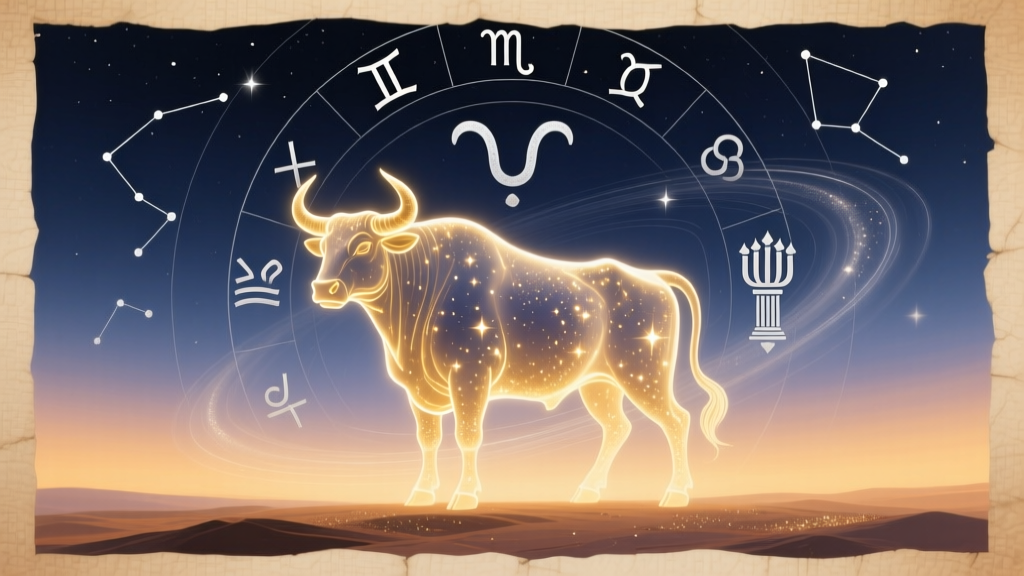
For over two millennia, the zodiac sign Taurus—spanning April 20 to May 20—has embodied steadfastness, sensuality, and quiet strength. Yet behind its modern astrological profile lies a deep well of mythic resonance: a celestial bull that carried gods, seduced queens, and anchored entire cosmologies. Unlike many signs whose symbolic origins are diffuse or syncretic, Taurus boasts one of the most vivid, cross-cultural origin stories in Western astrology—rooted in star maps, sacred cattle cults, and divine metamorphosis. This article traces the mythological lineage of Taurus from its earliest Sumerian echoes through Greek and Roman retellings, into Babylonian star catalogs and Vedic cosmology—and reveals how these ancient narratives continue to inform the psychological and behavioral hallmarks of the Taurus archetype today. Grounded in primary mythic sources and corroborated by modern astrological scholarship, this exploration goes beyond surface symbolism to illuminate why Taurus remains inseparable from themes of fertility, sovereignty, endurance, and sacred embodiment.
The Myth Behind Taurus
The myth behind Taurus is not a single story—but a layered palimpsest of celestial observation, agrarian ritual, and theological evolution. At its core lies humanity’s earliest recognition of the bull as a symbol of raw life force: virility, abundance, protection, and unyielding presence. Archaeological evidence confirms that bull veneration predates written language. The 17,000-year-old cave paintings at Lascaux in France feature striking, anatomically precise depictions of aurochs—the wild ancestor of domestic cattle—suggesting ritual significance long before zodiacal astronomy emerged. In Mesopotamia, the bull was associated with Enlil, god of wind and earth; in Egypt, Apis—the living bull of Memphis—was worshipped as an incarnation of Ptah and later Osiris, embodying resurrection and cosmic order. These pre-zodiacal traditions laid the foundation for Taurus’s inclusion as the first sign of the Babylonian zodiac around 1000 BCE, where it marked the vernal equinox—the moment the Sun entered the constellation and heralded spring’s rebirth. As Astro.com notes, Taurus is the only zodiac sign represented by a non-human creature that is both real and revered across continents—a testament to its primal archetypal weight. Its fixed earth nature reflects this grounding in tangible reality: Taurus does not symbolize abstract ideals but lived, embodied experience—fertility in soil, loyalty in relationship, resilience in adversity. To understand Taurus mythologically is to recognize that its story begins not with stars, but with hoofbeats echoing across millennia of human reverence.
Taurus in Greek Mythology
In Greek mythology, Taurus is indelibly linked to the tale of Zeus and Europa—a foundational myth that fuses divine desire, transformation, and geopolitical destiny. According to Hesiod’s Theogony and Ovid’s Metamorphoses, Zeus, enamored with the Phoenician princess Europa, transformed himself into a magnificent white bull—gentle-eyed, adorned with garlands, and radiating serene power. When Europa playfully climbed onto his back, he strode into the sea and swam to Crete, where he revealed his true form and fathered three sons: Minos, Rhadamanthus, and Sarpedon—future kings and judges of the underworld. This myth is far more than erotic allegory; it encodes cosmological and political truths. The bull’s journey from Phoenicia to Crete mirrors the historical transmission of writing, metallurgy, and religious practice from the Levant to Minoan civilization. Moreover, the bull’s whiteness signifies purity and divine authority—not brute force, but sovereign grace. As scholar Robert Graves observes in The Greek Myths, the bull represents the ‘earthly vehicle of the sky-god,’ linking heaven and soil. For Taurus natives, this myth illuminates core traits: the capacity to appear calm and approachable while harboring immense inner power; the instinct to nurture and protect those they cherish (Europa becomes queen and mother); and the slow, deliberate unfolding of destiny—Zeus does not rush Europa, nor does he dominate her; he invites, carries, and honors her agency. Modern astrologer Steven Forrest affirms this interpretation in The Changing Sky, noting that Taurus’s evolutionary lesson lies in ‘learning to wield stability as a form of sacred sovereignty—not control, but grounded presence.’
Taurus in Roman Mythology
Roman mythology absorbed and reframed the Greek Taurus narrative with distinct civic and agricultural emphasis. While retaining the Europa myth (recorded by Virgil and Hyginus), Rome elevated the bull to a symbol of gravitas—moral weight, civic duty, and economic vitality. The Roman deity Jupiter, counterpart to Zeus, retained the bull form in certain cult practices, particularly in rural festivals like the Fordicidia, held on April 15—just days before the Taurus season begins. During this rite, a pregnant cow was sacrificed to Tellus (Earth Goddess), and her unborn calf burned to ensure fertile fields. The ashes were later mixed with bean stalks and used in the Parilia, a purification festival honoring shepherds and boundaries—echoing Taurus’s role as guardian of thresholds and resources. Roman astrologers such as Marcus Manilius, in his first-century CE Astronomica, described Taurus as ‘the sign of enduring strength, rooted in the soil and loyal to its kindred.’ Unlike Greek portrayals emphasizing divine romance, Roman interpretations foregrounded Taurus’s function in societal continuity: land stewardship, marriage contracts (matrimonium required witnessed consent and dowry—Taurus values tangible commitment), and architectural permanence. The Capitoline Triad—Jupiter, Juno, and Minerva—was housed in a temple built on foundations laid by Etruscan engineers who aligned their sacred spaces with Taurus’s rising point. This practical reverence informs why Taurus individuals often excel in fields requiring patience and craftsmanship—architecture, viticulture, banking, and fine arts—where value accrues slowly and authentically. As the Astrology.com Zodiac Guide observes, ‘Taurus energy doesn’t chase trends—it cultivates legacy.’
Ancient Cultural Interpretations of Taurus
Beyond Greece and Rome, Taurus held profound meaning across ancient civilizations—each layer adding nuance to its archetypal identity. In Sumerian astronomy, the constellation was known as MUL.GU.LA (“The Great One”), associated with the god Dumuzi (Tammuz), whose annual descent into the underworld and return mirrored the bull’s seasonal disappearance and reappearance in the night sky—and symbolized agricultural cycles of death and regeneration. Babylonian star catalogues, such as the MUL.APIN tablets (c. 1000 BCE), list Taurus as the first constellation of the year, marking the equinox and governing the month of Ayyaru—when barley ripened and temple offerings peaked. In Vedic astrology, Vrishabha (Sanskrit for ‘bull’) governs April 14–May 14 and is ruled by Venus—the same planetary ruler as Western Taurus—emphasizing beauty, harmony, and sensual wisdom. Ancient Egyptians linked Taurus to Osiris, whose dismembered body was reassembled by Isis, and whose resurrection was celebrated during the Opet Festival, when the sacred bull Apis was paraded through Thebes. Notably, Apis was selected only if bearing specific markings—including a triangular patch on its forehead resembling the Hyades star cluster in Taurus. This convergence of biology, astronomy, and theology underscores Taurus’s unique status: no other zodiac sign has been physically incarnated in worship across multiple empires. A comparative overview of these interpretations reveals consistent threads:
| Culture | Name / Title | Associated Deity | Primary Symbolic Theme | Astronomical Significance |
|---|---|---|---|---|
| Sumerian | MUL.GU.LA (“The Great One”) | Dumuzi | Seasonal death & rebirth | Marked spring equinox; linked to barley harvest |
| Babylonian | GU.AN.NA (“Bull of Heaven”) | Ishtar’s celestial weapon | Divine wrath & cosmic order | First sign in MUL.APIN; governed Ayyaru |
| Egyptian | Apis Bull | Osiris / Ptah | Resurrection & sacred embodiment | Hyades cluster seen as bull’s face; Apis selected by celestial markings |
| Vedic | Vrishabha | Shukra (Venus) | Sensual wisdom & material harmony | Fixed earth sign; governs wealth, aesthetics, and longevity |
These parallels affirm that Taurus was never merely a ‘sign’—but a living cosmological principle anchoring human societies to natural and spiritual rhythms.
The Constellation Story of Taurus
The Taurus constellation is among the oldest recognized star patterns, visible year-round from mid-northern latitudes and dominating the winter sky. Its most prominent features—the V-shaped Hyades star cluster (representing the bull’s face) and the nearby Pleiades (his shoulder or collar)—are easily identifiable with the naked eye. Astronomically, Taurus contains Aldebaran, a red giant star marking the bull’s fiery eye, and the Crab Nebula (M1), the remnant of a supernova observed by Chinese astronomers in 1054 CE. But its mythic cartography is even richer. In Greek star lore, the Hyades were nymphs who nursed Dionysus and were placed in the sky as mourners—hence their name, derived from the Greek word for ‘to rain,’ as their rising coincided with spring rains. The Pleiades, daughters of Atlas and Pleione, fled Orion’s pursuit and were transformed into stars—yet their faintness reflects Taurus’s protective nature: the bull shelters them, just as Taureans often shield loved ones from harm. Medieval Arab astronomers called Taurus Al Thaur, preserving its bull identity, while Polynesian navigators used its position to guide voyages across the Pacific—naming it Te Taura (‘the rope’), signifying connection between realms. Crucially, Taurus straddles the ecliptic—the Sun’s apparent path—and thus hosts several key astronomical events: the Sun resides in Taurus from approximately April 20 to May 20; the Moon passes through it monthly; and eclipses occur here when lunar nodes align. This celestial centrality reinforces Taurus’s role as a ‘grounding node’ in the zodiac wheel—where cosmic forces stabilize, consolidate, and manifest. As NASA’s official star chart documentation confirms, Taurus remains a critical reference point for calibrating celestial navigation systems—even today’s GPS relies on stable stellar markers like Aldebaran. For the Taurus individual, this astronomical truth mirrors their psychological function: to be the still point in the turning world—to hold space, anchor vision, and transform potential into substance.
How Mythology Shapes the Taurus Archetype
Mythology does not merely decorate the Taurus profile—it constructs its psychological architecture. Every defining trait finds precedent in ancient narrative: the Taurean love of beauty stems from Venus-ruled Aphrodite’s association with the Cretan bull-cults; their resistance to change echoes the bull’s immovable stance in ritual processions; their fierce loyalty mirrors Europa’s lifelong devotion to Zeus and her sons; their appreciation for luxury reflects Apis’s gilded horns and embroidered robes. Jungian analyst Liz Greene, in The Astrological Neptune and the Quest for Redemption, argues that Taurus embodies the ‘instinctual self’—not the unconscious id, but the conscious, embodied will to persist, create, and belong. This is the ‘sacred cow’ principle: what is sustained, honored, and protected becomes holy. Modern neuroscience supports this: studies on interoception (the perception of internal bodily states) show Taurus-dominant individuals often exhibit heightened somatic awareness—aligning with mythic themes of tactile presence and sensory reverence. Furthermore, Taurus’s fixed modality—shared only with Leo, Scorpio, and Aquarius—reflects mythic constancy: unlike mutable signs that adapt or cardinal signs that initiate, fixed signs preserve. Thus, the Taurus archetype is less about passive inertia and more about active guardianship—of values, relationships, ecosystems, and cultural memory. When a Taurean refuses to compromise on ethics, invests decades in a craft, or restores heirloom gardens, they enact ancient rites of continuity. Their ‘stubbornness’ is mythic fidelity—the same resolve that kept Apis bulls alive for decades under strict ritual care, or that guided Babylonian priests in tracking Taurus’s heliacal rising for temple calendars. In essence, mythology teaches us that Taurus is not simply ‘born under the bull’—they are the bull’s earthly custodians.
Taurus Mythology Quick Reference
- Primary Greek Myth: Zeus as the white bull abducting Europa—symbolizing divine invitation, sovereignty, and generative union.
- Key Roman Ritual: Fordicidia (April 15) — sacrifice of pregnant cow to ensure agricultural fertility and civic stability.
- Ancient Names: Sumerian MUL.GU.LA; Babylonian GU.AN.NA; Egyptian Apis; Vedic Vrishabha.
- Constellation Markers: Aldebaran (the eye), Hyades (face), Pleiades (shoulder), Crab Nebula (M1).
- Planetary Ruler: Venus—linking Taurus to love, art, value systems, and embodied pleasure across all traditions.
- Element & Modality: Earth (tangible reality) + Fixed (enduring presence)—mythically expressed as sacred stewardship.
- Core Archetypal Motif: The Bull as Bridge—between heaven and earth, divine will and human action, transience and eternity.
Understanding Taurus through its mythology transforms astrology from horoscope entertainment into ancestral dialogue. It reminds us that when we speak of Taurean patience, we echo the slow turning of stars above Crete; when we admire their taste, we honor Apis’s golden collars; when we rely on their loyalty, we participate in a covenant older than alphabets. Taurus is not a personality type—it is a living relic of humanity’s first sacred contract with the earth.