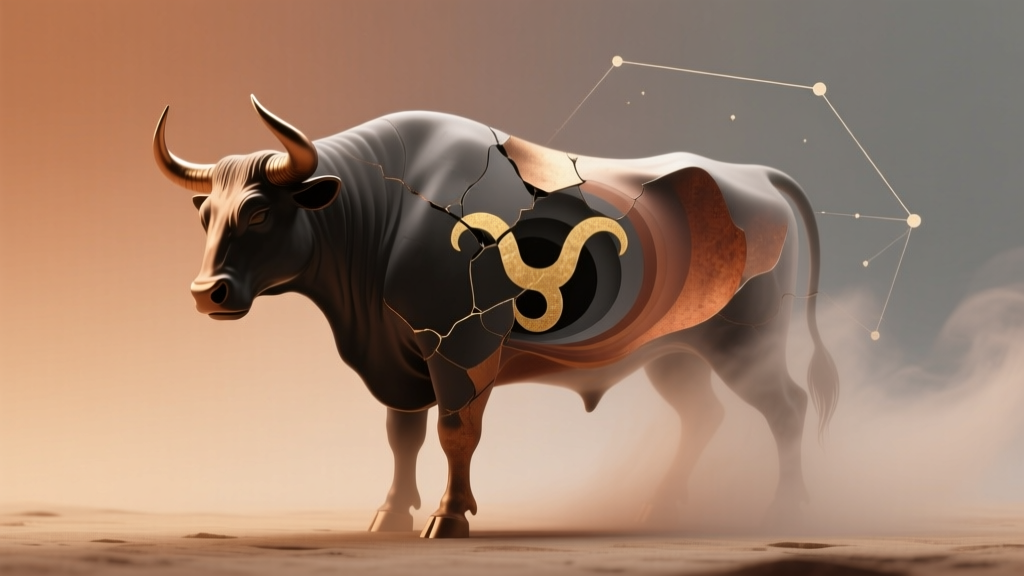
While Taurus is often celebrated for its loyalty, sensuality, and grounded presence, its enduring strength carries a quieter, more complex undercurrent: the shadow side. Ruled by Venus and anchored in the fixed earth element, Taurus embodies stability, devotion, and aesthetic appreciation — yet these very virtues can calcify into rigidity, control, and emotional suppression when unexamined. This article delves deeply into the shadow side of Taurus, moving beyond pop-culture stereotypes to illuminate how core Taurean strengths, when distorted by fear or trauma, manifest as toxic patterns. We examine not just what goes awry, but why — tracing each dark trait to its psychological root, its astrological signature, and its path toward integration. Drawing on classical astrology, depth psychology, and modern behavioral research, this guide offers Taurus natives and those who love them a compassionate, evidence-informed framework for recognizing, understanding, and transforming shadow expressions.
The Shadow Side of Taurus
The shadow, as defined by Carl Gustav Jung, represents the unconscious, repressed, or disowned aspects of the personality — qualities we refuse to acknowledge in ourselves but often project onto others. For Taurus, whose conscious identity revolves around security, consistency, and sensory harmony, the shadow emerges precisely where those values become inflexible dogmas. The Taurean shadow isn’t inherently malicious; rather, it’s the distortion of noble traits under pressure: loyalty becomes possessiveness, patience becomes passive aggression, reliability becomes immobility. Because Taurus is a fixed sign, its energy resists dissolution — which makes both its resilience and its resistance exceptionally potent. When Venusian values (beauty, pleasure, connection) are threatened, the shadow may respond not with grace, but with silent withdrawal, sulking, or covert manipulation — behaviors that preserve surface calm while eroding trust beneath. Astrologer Steven Forrest notes that fixed signs like Taurus carry ‘a deep need to prove their worth through endurance,’ which, when unbalanced, fuels compulsive self-reliance and an aversion to vulnerability (Forrest, Astrology Essentials). Unlike fire or air signs that externalize conflict, Taurus internalizes tension — letting resentment fester until it crystallizes into cold detachment or sudden, disproportionate outbursts. This inward containment makes the Taurean shadow especially difficult to confront, both for the individual and those around them. Yet acknowledging this hidden terrain isn’t about labeling Taurus as ‘difficult’ — it’s about honoring the full complexity of a sign that holds profound capacity for both unwavering love and quiet self-sabotage.
Taurus Fears and Insecurities
Beneath Taurus’s serene exterior lies a bedrock of existential anxieties — fears so deeply embedded they rarely surface as direct confession, but instead shape behavior at the somatic and relational level. At the core lies the fear of instability: not merely financial insecurity, but the visceral terror of losing grounding — of having one’s sense of safety, rhythm, or bodily autonomy disrupted. This stems from Taurus’s earthy constitution: as the first earth sign, it seeks tangible proof of safety — steady income, familiar surroundings, predictable routines, physical comfort. When these anchors feel threatened, anxiety doesn’t announce itself as panic; it manifests as hypervigilance around resources, obsessive planning, or hyper-focus on minor details (e.g., checking bank balances repeatedly, rearranging furniture for ‘better energy’). Closely tied is the fear of rejection rooted in worthiness. Because Venus rules Taurus, self-worth is often unconsciously tied to external validation — appearance, possessions, relationship status, or social approval. A Taurean may dismiss compliments while fixating on perceived flaws, believing, ‘If I’m not desirable, I’m not enough.’ This creates a paradox: outward confidence masking inner fragility. Psychologist and astrological researcher Erin Sullivan observed that Venus-ruled signs frequently equate love with possession — leading Taurus to conflate being loved with being owned or controlled, thereby confusing intimacy with containment (Sullivan, Astrology of the Ancient World). Other key insecurities include fear of irrelevance (‘What if my steady presence no longer matters?’), fear of change (‘What if I lose myself in transition?’), and fear of emotional exposure (‘If I show need, I’ll be seen as weak’). These fears rarely appear as spoken worries — instead, they animate behaviors: hoarding, procrastination disguised as ‘waiting for the right moment,’ or withholding affection as preemptive self-protection.
Defense Mechanisms of Taurus
Taurus employs highly embodied, slow-burning defense mechanisms — strategies that prioritize preservation over confrontation. These aren’t impulsive reactions, but carefully constructed psychological fortifications. Chief among them is stonewalling: withdrawing communication entirely, often accompanied by physical stillness (refusing to speak, turning away, remaining motionless). This isn’t mere silence — it’s a deliberate shutdown designed to halt escalation and regain control. Another hallmark is sensory avoidance: retreating into comfort zones — binge-watching, overeating, excessive sleep, or immersion in tactile pleasures (luxury fabrics, warm baths, rich food) — to numb emotional discomfort. While soothing in the short term, this avoidance delays processing and reinforces dependency on external regulation. Passive resistance is equally prevalent: agreeing verbally while failing to follow through, ‘forgetting’ commitments, or executing tasks with deliberate slowness — all subtle assertions of autonomy when direct assertion feels unsafe. Taurus also relies heavily on material compensation: acquiring possessions, upgrading environments, or investing in aesthetics to signal stability and deflect feelings of inadequacy. As noted by the International Society for Astrological Research (ISAR), fixed signs often use ‘tangible achievements as armor against intangible fears’ (ISAR, Research Papers Archive). Perhaps most insidious is emotional minimization: dismissing feelings as ‘irrational,’ ‘dramatic,’ or ‘not important’ — especially anger or grief — because acknowledging them threatens the illusion of control. These defenses serve a vital purpose: they protect the Taurean psyche from overwhelm. But when habitual, they corrode authenticity, strain relationships, and prevent growth. Healing begins not by eliminating defenses, but by recognizing their function — and cultivating gentler, more conscious alternatives.
When Taurus Is Under Stress
Stress reveals Taurus’s shadow in high-definition. Unlike mutable signs that adapt fluidly or cardinal signs that initiate solutions, Taurus under duress tends toward entrenchment. Its natural response is to dig deeper into existing structures — doubling down on routines, tightening control, or retreating into isolation. In acute stress, Taurus may exhibit hyper-materialism: sudden, compulsive spending sprees or obsessive focus on physical appearance as a desperate bid for reassurance. Chronic stress triggers emotional constipation: inability to name or express feelings, leading to somatic symptoms — jaw clenching, digestive issues, chronic fatigue — as unprocessed emotion settles in the body. Under prolonged pressure, Taurus may shift into its opposite sign, Scorpio, activating Scorpio’s shadow tendencies: suspicion, secrecy, vindictiveness, or manipulative power plays. This ‘Scorpio shadow flip’ is well-documented in evolutionary astrology — when Taurus feels existentially threatened, it abandons Venusian harmony for Scorpio’s intensity, seeking control through psychological leverage rather than mutual trust. A stressed Taurus might weaponize silence, withhold affection as punishment, or engage in covert surveillance (checking phones, monitoring social media). In extreme cases, this manifests as possessive jealousy masquerading as concern, or financial control disguised as ‘responsibility.’ Importantly, these aren’t character flaws — they’re stress responses rooted in neurobiological wiring. Research from the American Psychological Association confirms that chronic stress impairs prefrontal cortex function, reducing impulse control and increasing reliance on habitual, limbic-driven behaviors — precisely what amplifies Taurus’s fixed patterns (APA, Stress Physiology). Recognizing these stress signatures allows for timely intervention — whether through grounding techniques, boundary-setting, or professional support.
Toxic Taurus Patterns and How to Heal
Left unexamined, Taurus’s shadow can solidify into toxic relational and behavioral patterns. Below is a structured overview of five common manifestations, their roots, and evidence-based healing pathways:
| Toxic Pattern | Root Cause | Healing Strategy | Support Practice |
|---|---|---|---|
| Chronic Stubbornness (Refusing input even when beneficial) |
Fear of losing autonomy; equating flexibility with weakness | Cognitive reframing: ‘Adapting isn’t surrender — it’s strategic intelligence.’ | Weekly ‘curiosity journal’: Note 3 things you learned from someone else’s perspective. |
| Possessive Attachment (Controlling partners, finances, or time) |
Equating security with ownership; unresolved abandonment wounds | Attachment repair work: Identify attachment triggers; practice secure-base visualization | Therapy modalities: EFT (Emotionally Focused Therapy) or AEDP (Accelerated Experiential-Dynamic Psychotherapy) |
| Emotional Withholding (Using silence as punishment or shield) |
Learned helplessness; belief that vulnerability invites betrayal | Micro-expression practice: Name one feeling aloud daily, even if imperfectly | Somatic tracking: Notice where emotion lives in the body before speaking |
| Material Obsession (Defining self-worth through possessions/status) |
Venusian insecurity; cultural conditioning linking value to consumption | Values clarification exercise: List 5 non-material qualities you admire in others | Minimalism challenge: Remove one non-essential item weekly; reflect on emotional shifts |
| Passive-Aggressive Resistance (‘Yes, but…’ responses; intentional inefficiency) |
Fear of direct conflict; suppressed anger misdirected as obstruction | Assertiveness training: Replace ‘I can’t’ with ‘I choose not to — here’s why.’ | Nonviolent Communication (NVC) practice: Observe → Feel → Need → Request |
Healing requires patience — Taurus transforms not through speed, but through consistent, embodied repetition. Neuroscience shows that new neural pathways form best through repeated, low-stakes practice — aligning perfectly with Taurus’s natural pace. The goal isn’t to erase Taurean essence, but to expand its range: from ‘I must endure’ to ‘I choose to grow’; from ‘I own this’ to ‘I honor this’; from ‘I am safe only if controlled’ to ‘I am safe because I am whole.’
Embracing the Full Spectrum of Taurus
Shadow work for Taurus is ultimately an act of radical self-honoring. It asks the Bull to recognize that its greatest strength — steadfastness — is not diminished by softness, and its deepest security is not found in control, but in self-trust. The mature Taurus integrates Venus’s full expression: not just beauty and pleasure, but relational reciprocity; not just sensuality, but embodied presence without performance; not just loyalty, but loyalty to truth — including uncomfortable truths about oneself. This integration reveals Taurus’s luminous shadow gifts: the capacity for profound forgiveness (born of knowing one’s own imperfections), the wisdom of patient discernment (not inertia), the courage to build slowly and sustainably (not avoid risk), and the rare ability to hold space for others’ pain without fixing — simply being with it, like fertile soil holding seeds. When Taurus heals its shadow, it doesn’t become ‘less Taurean’ — it becomes more fully Taurean: grounded not in rigidity, but in resilient flexibility; devoted not to ideals, but to authentic connection; luxurious not in excess, but in presence. As astrologer Demetra George writes, ‘The fixed signs teach us that true stability arises not from resisting change, but from anchoring ourselves in the unchanging core of our being’ (George, Mysteries of the Veil). That core — the unshakeable, compassionate, sensual, sovereign self — is the light that dissolves the shadow.
Shadow Work Prompts for Taurus
These prompts invite gentle, embodied reflection — ideal for journaling, meditation, or therapeutic dialogue. Approach them without judgment; let answers arise slowly, like roots deepening in rich soil.
- When do I feel most ‘unsafe’? What physical sensations accompany that feeling? Where in my body do I hold that tension?
- What do I cling to — materially, relationally, or habitually — that I secretly fear losing? What would happen if I released it, even slightly?
- When I say ‘no,’ is it from clarity or fear? What am I protecting — and what might I be missing?
- Describe a time I withheld love or affection as protection. What was I afraid would happen if I offered it freely?
- What does ‘enough’ mean to me — financially, emotionally, physically? Where did that definition come from?
- If my body could speak, what would it ask me to stop ignoring?
- What pleasure do I deny myself — not from lack, but from guilt or unworthiness?
Remember: Shadow work is not about eradication. It’s about invitation — inviting the exiled parts home. For Taurus, the journey home begins not with upheaval, but with the quiet, courageous act of listening — deeply, patiently, and with unwavering kindness — to the wisdom held in the stillness.