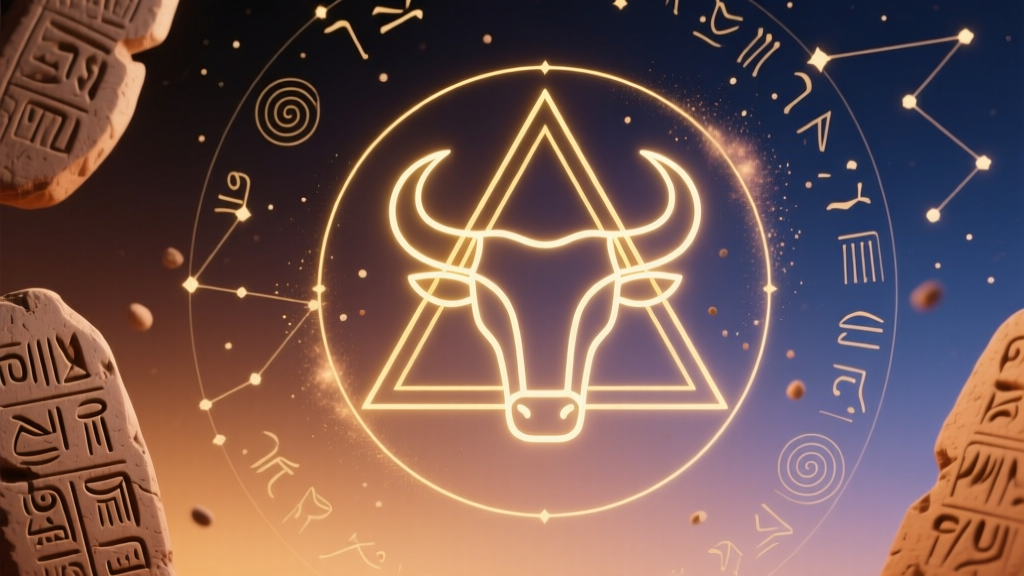
The Taurus Symbol: Origin and History
The Taurus symbol — a simple yet potent glyph resembling a bull’s head with horns — is one of the oldest and most enduring astrological signs in human history. Its roots stretch back over 5,000 years to the early Sumerian and Babylonian civilizations, where celestial observation was deeply interwoven with agricultural cycles, religious ritual, and royal authority. The constellation Taurus, marked by the prominent red giant Aldebaran (the 'Eye of the Bull'), was among the first star groups formally cataloged in cuneiform tablets dating to circa 3000 BCE. Ancient Mesopotamian astronomers associated this region of the sky with the spring equinox around 4000–2000 BCE — a time when the Sun appeared to rise in Taurus, heralding fertility, renewal, and the sacred bull’s role as a life-giving force.
By the time of the Egyptian New Kingdom (c. 1550–1070 BCE), Taurus was linked to the goddess Hathor — cow-headed, nurturing, and embodying joy, music, love, and motherhood. Her cult centered at Dendera featured elaborate reliefs showing the celestial bull carrying the solar barque across the heavens, reinforcing Taurus’ identity as a divine vessel for cosmic order and embodied divinity. In Greek mythology, Taurus became inseparable from Zeus’ transformation into a white bull to abduct Europa — a myth encoding themes of irresistible attraction, grounded power, and the soul’s initiation into earthly sovereignty. As noted by the Astro.com Zodiac Sign Archive, the bull motif persisted across cultures not as mere animal symbolism but as a cosmological anchor — representing stability, endurance, and the sanctity of physical existence.
Unlike later zodiac signs developed through Hellenistic synthesis (e.g., Aquarius or Scorpio), Taurus emerged organically from naked-eye astronomy and agrarian theology. Its glyph — ♂ (though more accurately rendered as ♉) — evolved from pictographic representations in proto-cuneiform scripts, where a stylized bull’s head with curved horns denoted both the animal and the concept of strength-in-stillness. This historical continuity underscores why Taurus remains the only sign whose symbol has never been substantially reinterpreted: its essence — rootedness, sensory reverence, and quiet authority — has remained unchanged across millennia.
Sacred Geometry Behind the Taurus Glyph
The Taurus glyph (♉) is deceptively minimal but rich in sacred geometric resonance. At first glance, it appears as a circle surmounted by two upward-curving arcs — often described as horns. Yet this configuration encodes precise mathematical and metaphysical relationships. The circle represents the eternal, unbroken cycle of manifestation — the womb of creation, the full Moon, and the soul’s wholeness. The two arcs are not arbitrary; they approximate the arc of a golden spiral’s initial turn — a logarithmic curve found in nautilus shells, sunflower seed arrangements, and galactic arms. This subtle alignment reflects Taurus’ intrinsic connection to natural proportion and organic growth, governed not by haste but by inherent rhythm.
Geometrically, the angle formed between the two horns approximates 60 degrees — the internal angle of an equilateral triangle, long associated in Pythagorean tradition with harmony, balance, and the element Earth. When inscribed within a circle, this triangular ‘horn-angle’ divides the circumference into six equal parts — generating the hexagram, a symbol of divine immanence and the union of heaven and earth. Notably, the Taurus glyph can be constructed using only compass and straightedge, adhering strictly to classical sacred geometry principles taught in medieval cathedral schools and preserved in esoteric traditions like Hermetic Qabalah. As scholar Dr. Nick Kollerstrom explains in his work on astrological glyphs, Skyscript’s Glyph Studies demonstrates how Taurus’ form mirrors the ‘vesica piscis’ — the almond-shaped intersection of two circles — a shape long venerated as the matrix of incarnation and the feminine principle in Christian, Islamic, and Hindu iconography.
Modern geomantic analysis further reveals that the vertical axis of the Taurus glyph aligns with the ‘axis mundi’ — the cosmic pillar connecting terrestrial and celestial realms. The horns point upward not toward transcendence alone, but toward *embodied* ascent: growth that emerges from deep roots, like a tree drawing nourishment from soil before lifting branches to light. This distinguishes Taurus from fire signs (whose glyphs emphasize upward thrust) or air signs (which prioritize horizontal connectivity). The glyph thus functions as a visual mantra: stillness charged with potential, form holding infinite becoming. Its elegance lies in economy — every line serves dual symbolic and energetic purposes, making it one of astrology’s most densely encoded sigils.
What the Taurus Symbol Represents
The Taurus symbol transcends mere zodiacal identification; it operates as a living archetype encoding core existential truths about embodiment, value, and sacred persistence. At its heart, the bull glyph signifies *uncompromising presence*. Unlike mutable or cardinal signs that initiate or adapt, Taurus embodies fixed Earth energy — unwavering, tactile, and anchored in the ‘now’. Its horns are not weapons of aggression but instruments of discernment: they push aside illusion, test authenticity, and delineate boundaries. A Taurus individual doesn’t seek novelty for its own sake; rather, they ask, “Does this nourish? Does this last? Does this honor my integrity?” — questions rooted in the glyph’s silent, steady posture.
This symbol also governs the alchemy of value-making. In Vedic astrology, Taurus (Vṛṣabha) is ruled by Venus and associated with Dhana — wealth in its fullest sense: material security, aesthetic richness, relational loyalty, and inner self-worth. The glyph visually echoes this: the circular base suggests containment and accumulation, while the horns lift upward like scales weighing substance against spirit. Psychologically, Carl Gustav Jung identified Taurus with the ‘Self’ archetype in its grounding aspect — the part of the psyche that integrates instinct and consciousness through sensory experience. As affirmed by the International Astronomy Education Center, Taurus’ symbolic function is to remind humanity that divinity expresses itself not only in stars but in soil, in breath, in the weight of a hand held in trust.
Moreover, the bull has long represented the untamed life force — libido in its original Latin sense: vital energy, not merely sexual desire. In Minoan Crete, bull-leaping frescoes depicted humans vaulting over bulls not to dominate but to harmonize with raw power. Similarly, the Taurus glyph invites conscious partnership with one’s instincts — honoring hunger, rest, pleasure, and resistance not as flaws but as sacred data. When misaligned, this energy manifests as stubbornness or possessiveness; when integrated, it becomes fidelity to truth, patience as strategy, and sensuality as sacrament. Thus, the symbol does not glorify inertia — it venerates *intentional slowness*, the kind that allows roots to deepen before fruit appears.
Taurus in Ancient Art and Architecture
Taurus’ symbolic presence saturates ancient art and architecture far beyond astrological charts — appearing as theological statement, civic emblem, and cosmological blueprint. The most iconic example is the Ishtar Gate of Babylon (c. 575 BCE), where glazed brick reliefs depict alternating rows of dragons (symbolizing Marduk) and bulls (symbolizing Adad, the storm god and protector of agriculture). These Taurus figures are not decorative; they served apotropaic (warding-off-evil) and calendrical functions, marking the gate as a liminal threshold aligned with the vernal equinox — when the Sun entered Taurus and signaled the start of the planting season. Each bull bore inscriptions invoking divine protection, confirming Taurus’ role as guardian of abundance and earthly order.
In Egypt, the Temple of Hathor at Dendera features a ceiling zodiac — a monumental bas-relief carved during the Ptolemaic period — where Taurus appears prominently near the northern ecliptic, flanked by lunar crescents and solar discs. Its placement correlates with the rising of Sirius, the star whose heliacal appearance heralded the Nile flood and the Egyptian New Year. Architecturally, the temple’s layout follows Taurian principles: thick walls, low doorways, and heavy columns shaped like sistrum handles (Hathor’s sacred rattle), all evoking solidity, resonance, and measured vibration. Similarly, the Neolithic site of Göbekli Tepe (c. 9600 BCE) — predating Stonehenge by 6,000 years — contains T-shaped pillars adorned with bull carvings, suggesting that the bull symbol was already central to proto-religious cosmology long before formal zodiacs existed.
Greek temples also encoded Taurian geometry. The Parthenon’s entasis — the subtle outward curvature of its columns — mimics the gentle arc of bovine horns, counteracting optical illusion while symbolically channeling Taurus’ principle of resilient form. Roman mosaics from Pompeii frequently feature the ‘Bull of Europa’ in domestic spaces, not as myth but as an invocation of prosperity and marital fidelity. Even Christian basilicas adopted Taurian motifs: the four Evangelists’ symbols include the ox (Luke), explicitly referencing sacrifice, service, and steadfast labor — qualities directly inherited from the ancient bull archetype. These cross-cultural repetitions confirm that Taurus was never merely a ‘sign’ but a foundational architectural and artistic grammar for expressing sacred stability.
The Deeper Spiritual Meaning of the Taurus Symbol
Spiritually, the Taurus symbol functions as an initiatory key — unlocking a path of devotion rooted in the physical world. While many spiritual traditions valorize transcendence, Taurus teaches *immanence*: the radical holiness of the here-and-now. Its glyph is a call to sanctify the senses — to taste food as communion, touch as blessing, silence as prayer, and rest as sacred reciprocity with Earth. In Tantric philosophy, this aligns with the concept of ‘bhoga’ — the conscious enjoyment of worldly experience as a means to awaken divine consciousness. The bull does not reject the material plane; it *inhabits* it fully, transforming matter into meaning through sustained attention and loving stewardship.
This spiritual orientation challenges modern dichotomies: sacred vs. secular, spirit vs. body, ambition vs. contentment. Taurus dissolves these binaries by asserting that true spirituality requires embodiment — that enlightenment without embodiment is abstraction, and embodiment without reverence is mere survival. The horns point upward not to escape Earth but to lift its gifts into higher resonance: a loaf of bread becomes Eucharist; a garden becomes Eden; a committed relationship becomes covenant. As emphasized in the AstroStyle Taurus Guide, this sign’s highest expression is ‘sacred materialism’ — the practice of investing love, ethics, and intention into tangible creation, whether building a home, composing music, cultivating soil, or raising children.
Mystically, the Taurus glyph mirrors the kundalini awakening process: the circle represents the dormant energy coiled at the base of the spine (Muladhara chakra), while the horns signify its ascent through the central channel — not as explosive force, but as steady, fertile unfolding. This makes Taurus a crucial ally in shadow work: its energy helps integrate repressed instincts, heal scarcity wounds, and reclaim worth independent of external validation. When meditated upon, the glyph invites grounding breathwork — inhaling stability, exhaling resistance — anchoring awareness in the body’s innate wisdom. Ultimately, the bull is not a symbol of brute force but of *sovereign presence*: the courage to stand still in a rushing world, to say ‘this is enough’, and to hold space for what truly matters — quietly, powerfully, eternally.
Taurus Symbol Quick Facts Table
| Attribute | Detail |
|---|---|
| Zodiac Position | Second sign (Earth element, Fixed modality) |
| Traditional Ruler | Venus |
| Modern Ruler (some schools) | Venus (no secondary ruler accepted widely) |
| Glyph Origin | Proto-cuneiform bull’s head (Uruk IV period, c. 3300 BCE) |
| Sacred Geometry Elements | Circle (wholeness), dual arcs (golden spiral, vesica piscis), 60° horn angle (harmony) |
| Ancient Associations | Hathor (Egypt), Adad (Babylon), Zeus-as-Bull (Greece), Nandi (Hinduism) |
| Chakra Correlation | Muladhara (Root Chakra) — grounding, survival, belonging |
| Spiritual Theme | Sacred Immanence — divinity expressed through embodiment, sustainability, and sensory reverence |