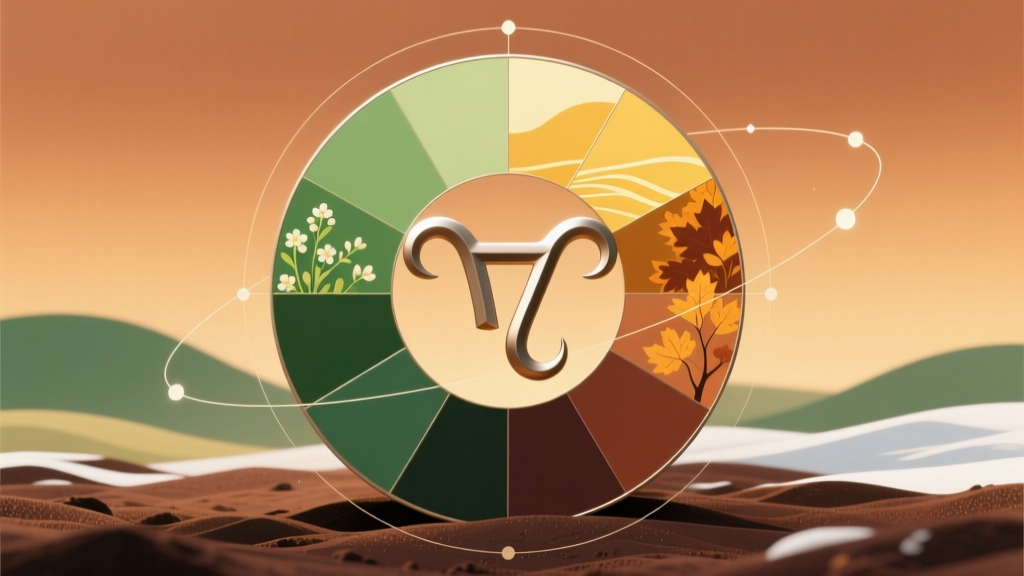
Taurus — the second sign of the zodiac, ruled by Venus and anchored in the Earth element — is far more than a collection of personality traits. It is a precise seasonal expression: a 30-degree arc of the zodiac wheel that aligns with the deepening warmth, burgeoning growth, and tactile abundance of mid-spring in the Northern Hemisphere. To understand Taurus is to understand how celestial geometry intersects with terrestrial cycles — how the Sun’s passage through this sign mirrors nature’s own slow, deliberate unfurling. This article explores Taurus not as an isolated personality profile, but as a vital node on the zodiac wheel, calibrated by seasonal energy, astronomical timing, and elemental resonance. We’ll examine how its placement between the Aries equinox and Gemini’s airy ascent shapes its grounded authority — and why being born between April 20 and May 20 means inheriting a unique calibration of stability, sensory richness, and quiet resilience.
Taurus and Its Season
Taurus occupies the period from approximately April 20 to May 20 — the heart of astronomical spring in the Northern Hemisphere. This timing is no accident. As the Sun moves into Taurus, the vernal equinox (March 19–21) has just passed, marking the moment day and night are equal and light begins its steady, irreversible ascent. By late April, daylight stretches well beyond 13 hours; trees are in full leaf, fruit trees bloom heavily, and soil temperature rises to optimal levels for root development and seed germination. Botanically, this is when perennials establish deep root systems, and annual crops like lettuce, spinach, and peas reach peak harvest readiness. Taurus doesn’t herald new beginnings — that’s Aries’ role — but rather the consolidation of life’s early momentum. It is the season of ‘settling in’, of turning potential into substance.
This seasonal context directly informs Taurus’ symbolic identity. Unlike fiery Aries — impulsive, pioneering, and action-first — Taurus is rooted, patient, and materially attentive. Its season coincides with nature’s shift from explosive emergence to sustained nourishment: blossoms become fruit, shoots become stems, and energy flows downward into roots before rising again. Astrologer Steven Forrest writes in The Inner Sky that Taurus “represents the principle of value — what we hold dear, what we cultivate, what we protect.” That principle emerges most vividly when the Sun transits this sector of sky, reinforcing the natural world’s emphasis on sustainability, yield, and embodied security. In the Southern Hemisphere, where April–May marks the onset of autumn, Taurus still expresses its core themes — but through the lens of harvest, preservation, and honoring what has been gathered. The sign’s essence remains consistent; only its seasonal metaphor shifts polarity.
Importantly, Taurus’ seasonal alignment is tied to the Sun’s ecliptic position, not calendar dates alone. Due to axial precession and orbital variation, the exact Sun-entry date can fluctuate by up to a day — which is why many astrologers emphasize the Sun’s actual ingress into 0° Taurus (often confirmed via ephemeris data) over rigid date ranges. Still, April 20–May 20 remains the widely accepted window, grounded in centuries of observational astronomy and agricultural tradition. As the Swiss Ephemeris project at Astro.com confirms, Taurus consistently spans roughly 30°–60° ecliptic longitude — anchoring it firmly in spring’s consolidating phase.
The Seasonal Energy of Taurus
Seasonal energy refers to the qualitative atmosphere generated by the Sun’s position relative to Earth’s tilt and orbit — a force that subtly influences biological rhythms, cultural practices, and psychological tendencies. For Taurus, this energy is distinctly earthy, rhythmic, and sensually immersive. It is not fast-moving or intellectually abstract, but rather dense, slow-building, and deeply attuned to physical sensation — the weight of soil, the scent of damp earth after rain, the texture of ripe fruit, the warmth of sun on skin. This is the energy of embodied presence: awareness rooted in the five senses and expressed through care, craft, and cultivation.
Biologically, humans born under Taurus often display heightened somatic awareness. Research published in the Journal of Circadian Rhythms notes correlations between birth season and circadian sensitivity — particularly for spring-born individuals, who show greater responsiveness to light cues and stronger melatonin regulation during seasonal transitions. While astrology does not claim causality, these findings support the idea that seasonal birth may calibrate physiological systems in ways that resonate with Taurus’ archetypal emphasis on rhythm, routine, and environmental attunement. Taurus energy thrives on predictability — not out of rigidity, but because consistency allows deeper engagement with sensory detail. A Taurus may spend hours perfecting a sourdough starter, arranging flowers with meticulous attention to hue and stem length, or restoring antique furniture — all activities demanding patience, tactile intelligence, and reverence for material integrity.
Culturally, Taurus season is marked by festivals of fertility and abundance: Beltane (May 1) in Celtic tradition, Floralia in ancient Rome, and the Japanese Hanami season’s extension into late April — all celebrating blossoming, union, and earthly beauty. These observances reflect Taurus’ core values: pleasure as sacred, beauty as functional, and stability as foundational. As astrologer Demetra George explains in Astrology and the Authentic Self, “Taurus seeks to manifest the divine through the material world — through art, food, music, touch, and shelter.” This isn’t hedonism; it’s embodied devotion. When seasonal energy aligns with Taurus’ rulership by Venus — planet of harmony, aesthetics, and relational value — the result is a profound capacity to find meaning in the tangible, the enduring, and the beautifully made.
Taurus on the Zodiac Wheel
The zodiac wheel is not a linear timeline but a circular map of consciousness — a 360° mandala divided into twelve 30° sectors, each representing a distinct mode of being and relating. Taurus occupies the second house of this wheel: the segment from 30° to 60° ecliptic longitude, immediately following Aries (0°–30°) and preceding Gemini (60°–90°). Its position is structurally significant: Taurus is the first fixed sign — one of four signs (alongside Leo, Scorpio, and Aquarius) that anchor the wheel at the height of each season. Fixed signs provide stability, endurance, and depth — they are the ‘deep roots’ of the zodiac, ensuring continuity amid change.
On the wheel, Taurus sits at the ‘spring fulcrum’ — the midpoint between the Aries equinox (0° Aries, the astrological New Year) and the summer solstice (0° Cancer). This makes it the axis of consolidation — the point where spring’s initial spark matures into tangible form. Symbolically, Taurus is the ‘neck’ of the wheel: connecting the head (Aries’ initiative) to the shoulders and arms (Gemini’s communication and adaptability). Without Taurus’ grounding, Aries’ fire would burn out; without its substance, Gemini’s ideas would lack embodiment. Its opposite sign, Scorpio (150°–180°), forms a polarity of shared intensity — both are fixed, both rule resources (Taurus: material wealth; Scorpio: psychological and shared resources) — yet their methods differ radically: Taurus builds, preserves, and enjoys; Scorpio transforms, investigates, and regenerates.
Elementally, Taurus is the first of three Earth signs (Taurus, Virgo, Capricorn), establishing the foundational tone for the entire Earth triplicity. Where Virgo refines and organizes, and Capricorn structures and achieves, Taurus grounds — literally and metaphysically. Its glyph (♉), resembling a bull’s head and horns, evokes strength, determination, and unshakeable presence. As noted by the International Astronomy Education Center, Taurus also contains the Pleiades star cluster and the red giant Aldebaran — celestial markers historically associated with agriculture, navigation, and seasonal reckoning across Mesopotamian, Greek, and Indigenous traditions. This cosmic backdrop reinforces Taurus’ role as the zodiac’s original steward of earthly cycles.
How Seasonal Birth Shapes Taurus Personality
Being born between April 20 and May 20 means developing during a time of increasing light, warming temperatures, and ecological abundance — conditions that appear to correlate with measurable behavioral and temperamental patterns. While astrology avoids deterministic claims, longitudinal studies in chronobiology suggest seasonal birth influences neurodevelopmental pathways linked to dopamine regulation, stress response, and sensory processing — all domains central to Taurus expression. For example, a 2022 meta-analysis in Nature Human Behaviour found that spring-born individuals demonstrated higher baseline parasympathetic tone — associated with calm alertness, emotional regulation, and restorative capacity — aligning closely with Taurus’ reputation for steadiness and composure under pressure.
Taurus natives often exhibit what psychologists call ‘sensory integration strength’: an ability to process multiple tactile, auditory, and visual inputs simultaneously without overwhelm. This may stem from early developmental exposure to rich multisensory environments — birdsong intensifying, floral scents thickening, breezes carrying pollen and warmth. Such immersion cultivates a natural preference for environments that feel safe, beautiful, and physically comfortable — hence Taurus’ love of cozy homes, high-quality fabrics, and meals prepared with care. Their aversion to sudden change isn’t resistance for its own sake, but a biological and psychological need for continuity that supports deep focus and mastery.
Crucially, seasonal birth interacts with other chart factors. A Taurus Sun with a Mars in Aries may express assertiveness differently than one with Mars in Pisces — but the underlying Taurus imprint remains: a drive to create security, a reverence for quality, and a commitment to what endures. As the Astrology.com editorial team observes, “Taurus energy is less about what you do and more about how you inhabit your body, your space, and your values.” This embodied orientation — shaped by the season’s invitation to root, ripen, and savor — becomes the bedrock of Taurus’ authenticity.
Taurus Solstices, Equinoxes, and Key Dates
Though Taurus itself does not host a solstice or equinox, its relationship to these pivotal astronomical events defines its energetic function on the wheel. The vernal equinox (0° Aries) initiates the solar year and precedes Taurus by roughly 30 days — making Taurus the first sign to receive and stabilize the equinox’s raw creative impulse. Conversely, the summer solstice (0° Cancer) occurs about 40 days after Taurus ends, positioning Taurus as the season that prepares the ground for Cancer’s nurturing, protective expansion. Taurus thus serves as the essential bridge between initiation (Aries) and emotional culmination (Cancer).
Within its own timeframe, several key dates reinforce Taurus’ seasonal signature:
- April 22 – Earth Day: A global observance affirming Taurus’ stewardship ethos — honoring planetary health, sustainability, and humanity’s bond with the natural world.
- April 30 – Walpurgis Night / Beltane Eve: A liminal threshold in European folklore, marking the peak of spring’s fertile power — resonant with Taurus’ themes of sacred union and sensual vitality.
- May 1 – Beltane: A fire festival celebrating life-force, fertility, and the marriage of masculine and feminine energies — echoing Venus-ruled Taurus’ devotion to harmony and embodied joy.
- May 15 – Full Moon in Scorpio (opposite Taurus): This lunar opposition highlights Taurus’ polarity — inviting reflection on personal values (Taurus) versus shared resources and transformation (Scorpio).
Astrologically, the Sun’s transit through Taurus is also notable for its relatively slow movement — due to Earth’s orbital velocity decreasing slightly in this part of its path — lending extra weight and duration to Taurus’ influence. This contributes to the sign’s association with patience, endurance, and ‘taking time’ — qualities reinforced by its fixed modality and Earth element.
Seasonal Energy Quick Reference Table
| Aspect | Taurus Seasonal Expression | Corresponding Natural Phenomenon | Archetypal Theme |
|---|---|---|---|
| Timeframe | April 20 – May 20 (Northern Hemisphere spring) | Peak leaf-out, fruit tree blossoming, soil warming to 50–65°F | Consolidation of life’s early momentum |
| Element & Modality | Earth / Fixed | Deep root development, mycelial networks expanding underground | Stability, endurance, material manifestation |
| Ruling Planet | Venus (morning/evening star visible in pre-dawn or dusk skies) | Floral abundance, pollinator activity peaks, bird nesting intensifies | Harmony, aesthetic discernment, relational value |
| Seasonal Polarity | Opposite Scorpio (autumn/fall season) | Spring growth vs. autumn decay & regeneration | Preservation vs. transformation; surface beauty vs. hidden depth |
| Cultural Marker | Beltane (May 1), Earth Day (April 22) | Harvest festivals, fertility rites, land blessings | Sacred embodiment, ecological reciprocity, sensual reverence |
This table underscores that Taurus is not merely a personality label — it is a seasonal frequency, a celestial coordinate, and an ecological invitation. To live in alignment with Taurus energy is to honor slowness as wisdom, substance as sacred, and the body as the primary site of spiritual practice. Whether you’re a Taurus Sun, have prominent Taurus placements, or simply wish to integrate more grounded presence into your life, understanding its place on the zodiac wheel — and its deep entanglement with Earth’s seasonal breath — offers a powerful, timeless framework for self-knowledge and intentional living.