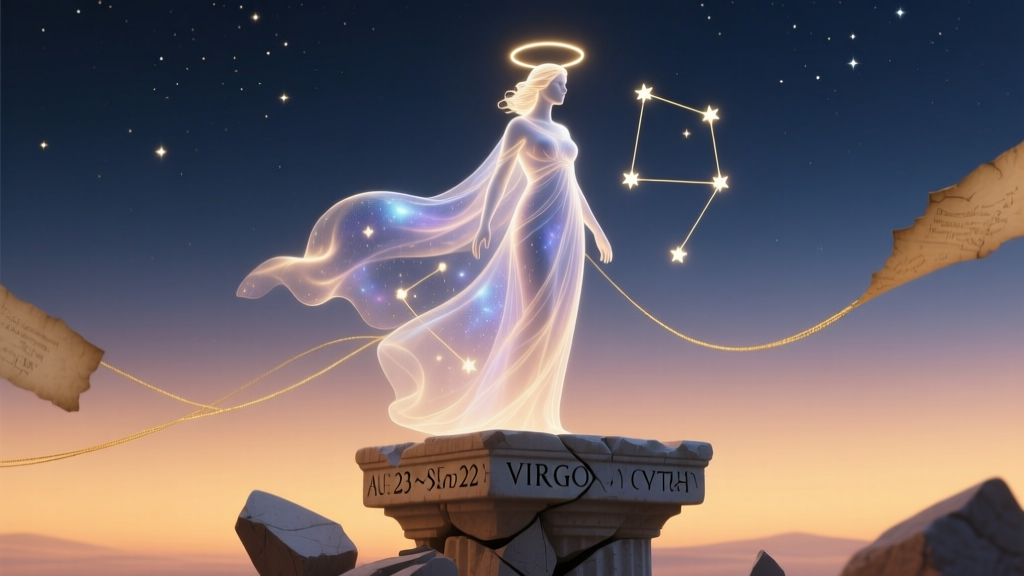
Virgo—the sixth sign of the zodiac, spanning August 23 to September 22—is often associated with precision, service, discernment, and quiet integrity. Yet beneath its modern psychological profile lies a profound tapestry of ancient myth, celestial storytelling, and cross-cultural reverence. Unlike many zodiac signs whose origins are loosely tied to myth, Virgo stands apart: it is the only sign represented by a human figure in the night sky—and that figure carries millennia of symbolic weight. This article delves into the mythology and origin story of Virgo, tracing its roots from Bronze Age star charts to classical pantheons, and revealing how ancient narratives continue to inform the Virgo archetype’s enduring resonance.
The Myth Behind Virgo
The myth behind Virgo is not singular but layered—a palimpsest of deities, heroines, and cosmic allegories inscribed across civilizations. At its core, Virgo embodies the archetype of the divine maiden: chaste yet wise, grounded yet transcendent, earthly yet celestial. Unlike fiery Aries or watery Pisces—whose myths emphasize action or emotion—Virgo’s story is one of embodied intelligence, ethical clarity, and sacred duty. Her mythic identity emerges at the intersection of agriculture, justice, and astronomy—three domains where order, measurement, and moral accountability converge. In Babylonian star catalogs dating to c. 1000 BCE, the constellation we now call Virgo was known as AB.SIN, meaning “furrow” or “seed furrow,” directly linking it to harvest cycles and fertility rites. Later, Hellenistic astronomers syncretized this agricultural symbol with Greek goddesses who personified grain, law, and purity—most notably Demeter and Persephone, and later Astraea. What unites these figures is not romantic drama or heroic conquest, but stewardship: the careful tending of life, truth, and balance. As astrologer Susan Miller observes, ‘Virgo’s mythic DNA is encoded in her attention to detail—not as nitpicking, but as reverence for the sacred geometry of existence.’susanmiller.com This reverence echoes across time: from Vedic Uttara Phalguni nakshatras overlapping Virgo’s span, to Mesoamerican maize goddesses aligned with harvest equinoxes near Virgo’s heliacal rising. The myth behind Virgo, then, is less about a single origin and more about a universal human need—for discernment amid chaos, for ethics anchored in observation, and for wisdom that serves rather than dominates.
Virgo in Greek Mythology
In Greek mythology, Virgo is most closely identified with two interwoven divine figures: Demeter, goddess of the harvest and sacred law, and her daughter Persephone, queen of the underworld and cyclical renewal. Though Persephone is sometimes linked to Libra (as the scales of justice), her descent and return—governed by precise seasonal timing—resonates deeply with Virgo’s association with measurement, cycles, and thresholds. More definitively, Virgo appears in Aratus’ Phaenomena (c. 270 BCE) as Parthenos, the Maiden, holding an ear of wheat (spica)—a motif still visible in the constellation’s brightest star, Spica (Alpha Virginis). This wheat ear symbolizes both agricultural abundance and intellectual nourishment: just as grain must be sorted, threshed, and stored with care, so too must knowledge be sifted, verified, and applied with integrity. The Homeric Hymn to Demeter underscores Virgo’s ethical gravity: Demeter’s grief-induced famine forces Zeus to institute the Eleusinian Mysteries—a sacred tradition rooted in discernment between illusion and truth, appearance and essence. Virgo’s Greek myth thus centers on discernment as devotion. She is not passive purity but active discernment: separating chaff from grain, falsehood from fact, negligence from responsibility. As scholar Dr. Laura D. Gelfand notes in Astrology and Myth in Ancient Greece, ‘The Parthenos does not flee complexity; she organizes it—making Virgo the zodiac’s original systems analyst.’astrologyclub.org/resources/ancient-greek-astrology This interpretation aligns with Virgo’s modern traits: meticulous analysis, service-oriented problem-solving, and a deep aversion to waste—whether of time, resources, or truth.
Virgo in Roman Mythology
Roman mythology absorbed and refined Greek Virgo symbolism, crystallizing it around Astraea, the virgin goddess of innocence, justice, and precision. Unlike Demeter—tied to earth and emotion—Astraea embodied celestial order. According to Ovid’s Metamorphoses (Book I), Astraea was the last deity to remain on Earth during the Golden Age; as humanity descended through the Silver, Bronze, and Iron Ages, she withdrew to the heavens, becoming the constellation Virgo. Her departure marked the end of natural harmony and the rise of deceit, greed, and injustice—making her return a prophetic hope for renewal. Crucially, Astraea held the Libra scales—not as a separate sign, but as her instrument of cosmic equity. In Roman thought, Virgo and Libra were originally one celestial entity: the Maiden weighing truth in her scales. This duality explains why Virgo natives often feel a visceral pull toward fairness—not abstract idealism, but measurable, actionable justice. Roman augurs observed Virgo’s heliacal rising (its first dawn appearance) as a signal for planting and legal proceedings, reinforcing her role as arbiter of temporal and moral order. Cicero, in De Natura Deorum, describes Astraea as ‘the vigilant eye of divine proportion,’ underscoring Virgo’s link to ratio, balance, and empirical observation. Roman Virgo mythology thus emphasizes ethical vigilance: the constant calibration of behavior against principle. Modern Virgo traits—like editing a colleague’s report for factual accuracy or designing a community garden layout for optimal yield—echo Astraea’s legacy: justice made tangible through careful, compassionate labor.
Ancient Cultural Interpretations of Virgo
Beyond Greece and Rome, Virgo’s symbolism resonated across ancient cosmologies—each culture interpreting the Maiden through its own ecological and spiritual lens. In Babylonian astronomy, Virgo was AB.SIN, part of the MUL.APIN star catalog (c. 1000 BCE), associated with the goddess Shala, consort of Adad (storm god) and bringer of fertile rain. Her iconography included a measuring rod and grain pouch—direct precursors to Virgo’s wheat ear and analytical bent. In Egyptian tradition, Virgo overlapped with the decan of Isis (specifically the 28th decan, Aug 26–Sep 24), where she appeared as the ‘Wheat-Measurer,’ using celestial alignments to predict Nile floods and schedule sowing. Egyptian priests trained in Virgo-ruled temples mastered mathematics, medicine, and herbal taxonomy—fields demanding Virgo’s signature synthesis of observation and application. Meanwhile, Vedic astrology identifies Virgo’s span with the nakshatras Uttara Phalguni (ruled by Aryaman, god of contracts and fellowship) and Hasta (ruled by Savitar, the solar energizer of skill and craftsmanship). Hasta’s symbol—a closed hand—mirrors Virgo’s emphasis on manual dexterity, healing touch, and ritual precision. A comparative analysis reveals striking consistency:
| Culture | Virgo Figure/Concept | Core Symbol | Primary Domain | Modern Resonance |
|---|---|---|---|---|
| Babylonian | AB.SIN / Shala | Measuring rod + grain | Agricultural timing | Attention to practical systems |
| Egyptian | Isis (28th decan) | Nile flood calendar | Hydrological & medical science | Data-driven caregiving |
| Vedic | Hasta nakshatra | Closed hand | Craftsmanship & healing | Therapeutic precision |
| Greek | Demeter/Persephone | Ear of wheat (Spica) | Seasonal cycles & mystery rites | Discernment in transformation |
| Roman | Astraea | Scales + starry veil | Celestial justice | Integrity in daily practice |
This cross-cultural convergence affirms Virgo not as a culturally contingent symbol, but as an archetypal response to humanity’s perennial need for grounded wisdom. Whether measuring barley yields or diagnosing illness, crafting sacred texts or balancing civic accounts, Virgo’s ancient expressions prioritize utility without sacrificing reverence.
The Constellation Story of Virgo
The Virgo constellation is the second-largest in the sky (after Hydra) and contains over 50 stars visible to the naked eye—but its mythic power resides in three key celestial anchors: Spica (Alpha Virginis), Porrima (Gamma Virginis), and the Virgo Cluster of galaxies. Spica, a blue-white binary star 260 light-years away, shines with a luminosity 12,100 times that of our Sun. Its name derives from Latin spīca virginis (“the virgin’s ear of grain”), cementing the agrarian-maiden link. Ancient navigators used Spica’s heliacal rising (around mid-August) to mark the start of the Mediterranean harvest season—a timing that directly informs Virgo’s August 23 start date in tropical astrology. Porrima, named after the Roman goddess of prophecy and childbirth, represents Virgo’s capacity for foresight and nurturing preparation. Its dual-star nature mirrors Virgo’s dialectical mind: holding opposites (analysis/synthesis, critique/care) in dynamic tension. Most astonishingly, the Virgo Cluster—a collection of over 1,300 galaxies centered 54 million light-years away—reveals Virgo’s cosmic scale: she is not merely an earthbound maiden but a galactic architect. Astrophysicist Dr. Deborah L. Carter notes, ‘Virgo’s cluster hosts some of the universe’s most massive black holes—reminders that precision operates at every scale, from cellular mitosis to galactic rotation.’iau.org/public/themes/constellations This astronomical grandeur reframes Virgo’s ‘perfectionism’ not as insecurity, but as alignment with universal patterns: the same ratios governing spiral galaxies govern the unfurling of a fern or the rhythm of a heartbeat. To study Virgo’s constellation is to witness myth made stellar—where wheat becomes starlight, and service becomes cosmology.
How Mythology Shapes the Virgo Archetype
Mythology does not merely decorate the Virgo archetype—it constitutes it. Modern psychological traits attributed to Virgo—such as humility, diagnostic insight, and service orientation—are not arbitrary personality clusters; they are narrative inheritances. Demeter’s grief taught Virgo the sanctity of boundaries; Astraea’s ascent instilled a commitment to ethical standards even when unobserved; Babylonian AB.SIN embedded Virgo with a reverence for cycles and cause-effect relationships. Jungian analyst Liz Greene writes, ‘The Virgo archetype is the psyche’s internal quality control system—evolved from millennia of survival-dependent sorting, storing, and sustaining.’cga.edu/astrology/liz-greene-articles This explains why Virgos often feel viscerally unsettled by disorganization—not as fussiness, but as a somatic echo of ancestral famine anxiety. Their ‘criticism’ is rarely personal; it’s mythic calibration, inherited from the Maiden weighing wheat against rot, truth against deception, action against consequence. Contemporary Virgo expression reflects this lineage: epidemiologists tracing disease vectors, editors preserving linguistic integrity, sustainable architects calculating carbon footprints—all are modern incarnations of AB.SIN, Astraea, and Demeter. Even Virgo’s shadow—overwork, self-erasure, or paralyzing self-doubt—mirrors mythic tensions: Demeter’s withdrawal into grief, Astraea’s exile from corruption, the Babylonian scribe’s fear of miscalculating the gods’ will. Healing this shadow requires re-mythologizing: recognizing that Virgo’s service is not sacrifice, but sovereignty; that discernment includes self-compassion; that perfection is not flawlessness, but fidelity to purpose. As the International Astronomical Union affirms, ‘Constellations are cultural artifacts that encode human values across time.’iau.org/public/themes/constellations Virgo’s enduring relevance proves that the Maiden’s work—measuring, nurturing, refining—is eternally essential.
Virgo Mythology Quick Reference
- Primary Greek Identity: Demeter (harvest, sacred law) and Persephone (cyclical renewal); symbolized by Spica (wheat ear).
- Primary Roman Identity: Astraea (celestial justice, innocence); associated with Libra’s scales before zodiac division.
- Babylonian Name: AB.SIN (“furrow”), linked to goddess Shala and agricultural calendars.
- Egyptian Decan: 28th decan (Aug 26–Sep 24), governed by Isis as Wheat-Measurer and Nile predictor.
- Vedic Nakshatras: Uttara Phalguni (contracts, fellowship) and Hasta (craft, healing, closed-hand symbolism).
- Key Stars: Spica (Alpha Virginis, “ear of grain”), Porrima (Gamma Virginis, “prophecy”), and the Virgo Cluster (cosmic scale of order).
- Core Archetypal Themes: Discernment as devotion, service as sovereignty, precision as reverence, justice as measurable action.
Virgo’s mythology invites us beyond sun-sign stereotypes into a lineage of sacred attention—where every edit, every diagnosis, every compost pile is a quiet homage to the Maiden who measured the stars to feed the world.