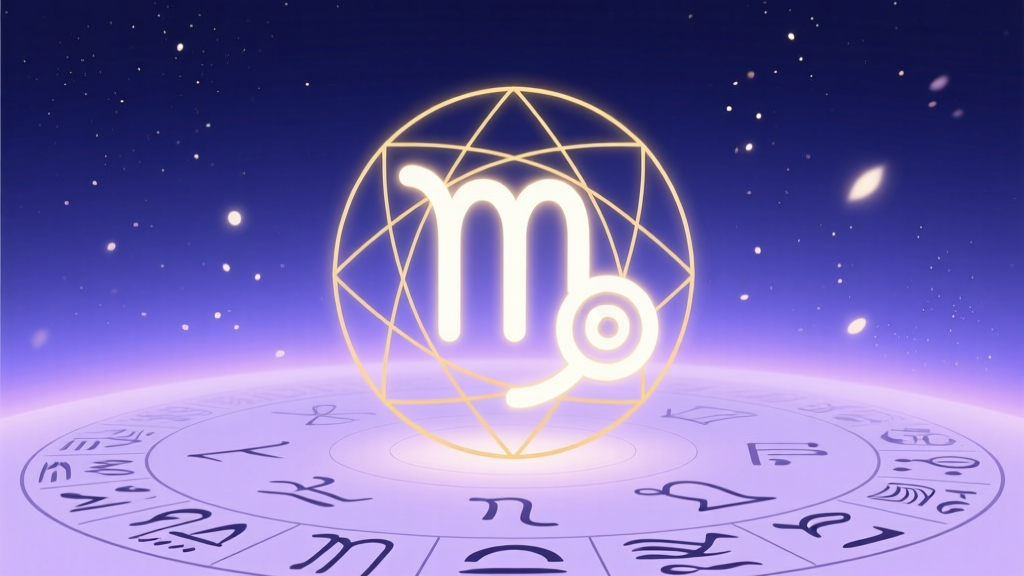
The Virgo symbol — a stylized 'M' with a descending curl and looping tail — is among the most enigmatic glyphs in the zodiac. Unlike Leo’s bold lion or Scorpio’s sharp scorpion, Virgo’s glyph appears abstract, even cryptic at first glance. Yet this simplicity conceals layers of sacred meaning rooted in millennia of astronomical observation, mythic tradition, and symbolic geometry. For those born between August 23 and September 22, the Virgo symbol is far more than an astrological shorthand: it is a visual mantra encoding themes of discernment, service, purity, and divine order. This article delves deeply into the Virgo glyph not as a mere signifier, but as a sacred emblem — tracing its historical lineage, decoding its geometric intelligence, interpreting its theological resonance, and revealing why ancient civilizations embedded its form into temples, manuscripts, and cosmological diagrams.
The Virgo Symbol: Origin and History
The Virgo symbol (♍) traces its earliest identifiable lineage to Babylonian astronomy, where the constellation was associated with the goddess Shala — deity of grain, fertility, and compassion — often depicted holding an ear of barley. By the 7th century BCE, Babylonian star catalogs such as the MUL.APIN listed the ‘Furrow’ (a name for Virgo’s brightest star, Spica) as one of the 17 constellations marking the ecliptic path. The Greeks later syncretized this figure with Demeter and her daughter Persephone — linking Virgo to cycles of harvest, descent, and renewal. In Hellenistic astrology, the glyph evolved from cuneiform representations of ‘furrow’ or ‘ear of wheat’ into the curvilinear form we recognize today. Claudius Ptolemy’s Tetrabiblos (2nd century CE), the foundational text of Western astrology, codified Virgo as the sixth sign, ruled by Mercury, and described its nature as ‘earthly, feminine, and mutable’ — qualities mirrored in the glyph’s grounded yet fluid structure. Medieval Arabic astrologers like Al-Biruni preserved and refined these interpretations, noting that the glyph’s descending stroke represented ‘the fall of divine wisdom into matter’, while the loop signified ‘the cyclical return of understanding’. As noted by the Astro.com Encyclopedia, the symbol’s earliest Greek inscriptions show variations resembling a coiled serpent or a stylized ‘K’ — both linked to concepts of knowledge (gnosis) and karmic precision. Its standardization occurred gradually through Renaissance manuscript traditions, particularly in works like Johannes Kamateros’ Compendium of Astrology (12th c.), where the glyph appears consistently as a closed loop with a downward arc — a form that would endure in printed ephemerides and almanacs for centuries.
Sacred Geometry Behind the Virgo Glyph
The Virgo glyph is a masterclass in sacred geometry — a minimalist composition rich in proportional harmony and symbolic symmetry. At its core lies a vertical line (representing the axis mundi or world pillar), intersected by a horizontal crescent curve that descends from left to right, terminating in a closed loop. When overlaid on the Flower of Life pattern or inscribed within a golden ratio rectangle, the glyph reveals precise geometric relationships: the height of the vertical stem equals 1.618 times the diameter of the terminal loop — echoing phi proportions found in natural growth patterns, from sunflower seed arrangements to nautilus shells. Esoteric scholars such as Robert Lawlor, in his seminal work Sacred Geometry: Philosophy and Practice, identifies the Virgo glyph as an embodiment of the ‘descending spiral’ — a motif representing involution, the inward journey of consciousness into form. The loop itself approximates a cardioid curve (heart-shaped), subtly affirming Virgo’s association with compassionate service and discerning love — not emotional impulsivity, but love refined through analysis and care. Furthermore, the glyph’s negative space forms a near-perfect vesica piscis when mirrored — the almond-shaped intersection of two circles symbolizing the meeting of heaven and earth, spirit and matter. This geometry aligns with Virgo’s dual rulership: Mercury (mind, logic, communication) and, in some traditional systems, Chiron (wounded healer, embodied wisdom). As the Astrology.com Virgo profile observes, ‘Virgo doesn’t just see details — it sees how each detail fits into a sacred whole.’ That holistic vision is encoded in the glyph’s balance: neither purely linear nor wholly circular, it harmonizes measurement (Mercury) with receptivity (Earth), intellect with humility. Modern geomantic studies conducted by the Sophia Centre for the Study of Cosmology in Culture confirm that medieval astrological manuscripts consistently placed the Virgo glyph at key geometric nodes in mandala-style zodiac wheels — always aligned with the ‘southwest gate’, the direction associated with introspection, purification, and earthly stewardship.
What the Virgo Symbol Represents
Beyond its visual form, the Virgo symbol functions as a semantic cipher — each component carrying distinct yet interwoven meanings. The vertical stem signifies integrity, uprightness, and moral clarity: Virgo’s commitment to truth-telling, even when inconvenient. The descending arc embodies humility — the willingness to descend from abstraction into practical application, from theory into service. It reflects Virgo’s aversion to pretense and its reverence for functional excellence. The closed loop at the base is perhaps the most profound element: it denotes completion, self-containment, and cyclical renewal — not perfection as flawlessness, but perfection as wholeness achieved through refinement. This loop also echoes the ouroboros, suggesting Virgo’s capacity to transform criticism into growth, chaos into order, and fragmentation into integration. Psychologically, Carl Gustav Jung identified Virgo as the archetype of the ‘Wounded Healer’, whose symbolic labor involves sorting the ‘wheat from the chaff’ — a process of conscious discrimination essential to individuation. In The Jungian Center’s analysis of Virgo, this is framed as ‘the sacred act of discernment’: not judgment, but careful differentiation that honors complexity while honoring boundaries. The glyph thus represents Virgo’s core mission: to serve as a vessel for divine order — not imposed rigidly, but cultivated with patience, precision, and quiet reverence. It is no accident that herbalists, editors, clinicians, and quality assurance specialists — all professions demanding meticulous attention and ethical rigor — are overrepresented among Virgos. Their symbol does not celebrate grand gestures, but the sacredness of the small: the alignment of a comma, the calibration of a dosage, the gentle correction of a misstep. In this light, the Virgo glyph becomes a devotional icon — a reminder that holiness resides not only in transcendence, but in the faithful tending of the immediate, the tangible, and the true.
Virgo in Ancient Art and Architecture
While less flamboyantly depicted than Aries or Taurus, Virgo’s symbolic presence permeates ancient art and sacred architecture — often encoded rather than overt. In the Temple of Hathor at Dendera (Egypt, 1st century BCE), Virgo appears in the famed Dendera Zodiac ceiling as a woman holding a stalk of wheat — her form aligned precisely with the decan (10-degree segment) governing health, healing, and ritual purity. Notably, her glyph is carved not as a standalone sign, but integrated into the border of the central zodiac circle — a placement emphasizing Virgo’s role as a mediator between celestial order and terrestrial life. Similarly, in the Roman Mithraeum of Santa Prisca (2nd century CE), Virgo is represented among the seven planetary deities flanking Mithras, holding a sheaf and standing beside Mercury — reinforcing the Mercury-Virgo intellectual-service axis. Architecturally, Virgo’s influence emerges in Gothic cathedral design: the north transept portals of Chartres Cathedral feature sculpted lunettes showing Virgo as the ‘Sower’, her glyph subtly echoed in the spiral volutes of column capitals — a nod to the sign’s connection with seeding, cultivation, and measured growth. In Mesopotamian cylinder seals, Virgo appears as the ‘Hand of Ishtar’, a stylized hand holding grain — the hand itself forming a glyph-like configuration matching the vertical stem and curved loop. Even in pre-Columbian Mesoamerica, the Maya Long Count calendar correlates the 18th month, Xul, with Virgo-like attributes: purification rituals, maize processing, and scribe training — all governed by the god Ah Puch in his benevolent aspect, overseeing transitions through careful preparation. These cross-cultural parallels suggest a universal archetypal resonance: Virgo as the guardian of thresholds — between seasons, states of being, and levels of awareness — whose symbol anchors cosmic rhythm in human-scale practice.
The Deeper Spiritual Meaning of the Virgo Symbol
Spiritually, the Virgo symbol invites contemplation of service as sacrament. In esoteric Christianity, Virgo corresponds to the Annunciation — not merely Mary’s passive acceptance, but her active, intelligent ‘yes’ to divine will, grounded in discernment and readiness. The glyph mirrors the gesture of blessing with the right hand: palm open, fingers slightly curled — a posture of offering, not domination. In Kabbalah, Virgo maps to the sephirah Hod (Glory), associated with ritual, humility, and the power of speech to sanctify — aligning with Mercury’s rulership and the glyph’s emphasis on articulate precision. The loop at the base resonates with the Hebrew letter Samekh, meaning ‘support’ or ‘prop’, symbolizing divine sustenance in times of testing. Sufi traditions link Virgo to the concept of taharah — ritual and inner purification — where the descending arc represents the soul’s surrender to divine refinement. Contemporary spiritual teachers like Caroline W. Casey, author of The Goddess Letters, interprets the Virgo glyph as ‘the signature of the Earth Priestess’: one who tends altars not of stone, but of daily life — kitchens, clinics, classrooms, gardens — transforming mundane acts into liturgy through presence and care. This interpretation reframes Virgo’s much-misunderstood ‘criticism’ as sacred accountability: the courage to name what harms, what distorts, what obscures truth — so that healing may begin. The glyph thus becomes a meditative focus: gazing upon its clean lines cultivates mental clarity; tracing its curve with the finger grounds anxiety; contemplating its loop fosters acceptance of life’s necessary cycles of release and renewal. Ultimately, the Virgo symbol teaches that divinity is not distant, but woven into the fabric of the well-ordered, the ethically tended, the compassionately detailed — and that true spirituality begins not with escape, but with exquisite attention.
Virgo Symbol Quick Facts Table
| Feature | Description | Symbolic Correlation |
|---|---|---|
| Glyph Form | Vertical stem + descending crescent + closed terminal loop | Axis mundi, descent into matter, cyclical wholeness |
| Classical Ruler | Mercury | Mind, communication, analysis, adaptability |
| Element & Modality | Earth / Mutable | Practicality grounded in change; adaptability through discernment |
| Ancient Associations | Shala (Babylon), Demeter/Persephone (Greek), Isis (Egypt) | Grain, harvest, healing, motherhood, sacred service |
| Sacred Number | 6 | Harmony, balance, nurturing, responsibility (6th sign) |
| Key Spiritual Theme | Discernment as devotion | Seeing clearly → serving wisely → healing wholly |
In conclusion, the Virgo symbol (♍) is not a relic, but a living glyph — a concentrated field of meaning that continues to inform psychological insight, artistic expression, and spiritual practice. For those born between August 23 and September 22, it is both mirror and map: reflecting their innate gifts of analysis, empathy, and dedication, while guiding them toward their highest vocation — the sacred work of making the world more coherent, more cared for, and more true. To understand Virgo is to recognize that the most profound revolutions begin not with fire, but with a single, well-placed seed — and that the hand that plants it, examines it, and protects it, bears a symbol older than language, written in the geometry of grace.